7 Myths About Industrial Automation
By DBR77 Team · Published · Updated


The most common myths about industrial automation are that it only pays in large plants, that it is always too expensive, that it means buying a robot, that it needs high volume and one product, that collaborative robots need no safety work, that projects take years, and that you only learn whether a solution works after installation. Each myth holds a grain of truth, which is why it survives. In a mid-size plant, though, the real limits are usually different: an unclear process, missing numbers and offers that cannot be compared. Turn each myth into a question you can answer with your own plant data, and the decision gets much easier.
Why myths stop more projects than technology does
A myth ends a discussion without anyone having to own a decision. "We are too small for robots" sounds prudent and costs nothing this quarter.
The beliefs do not come from nowhere. In McKinsey's survey of industrial leaders, 71 percent named the capital cost of robots as a barrier and 61 percent named their company's lack of automation experience. Those are real limits. The myth starts when they become a general rule ("automation is not for plants like ours") instead of a number checked against one station.
Meanwhile the technology is no longer rare. The International Federation of Robotics counted 542,000 industrial robots installed worldwide in 2024, more than double the number from ten years earlier. With that many installations, what a plant needs to check is whether the technology fits a specific station.
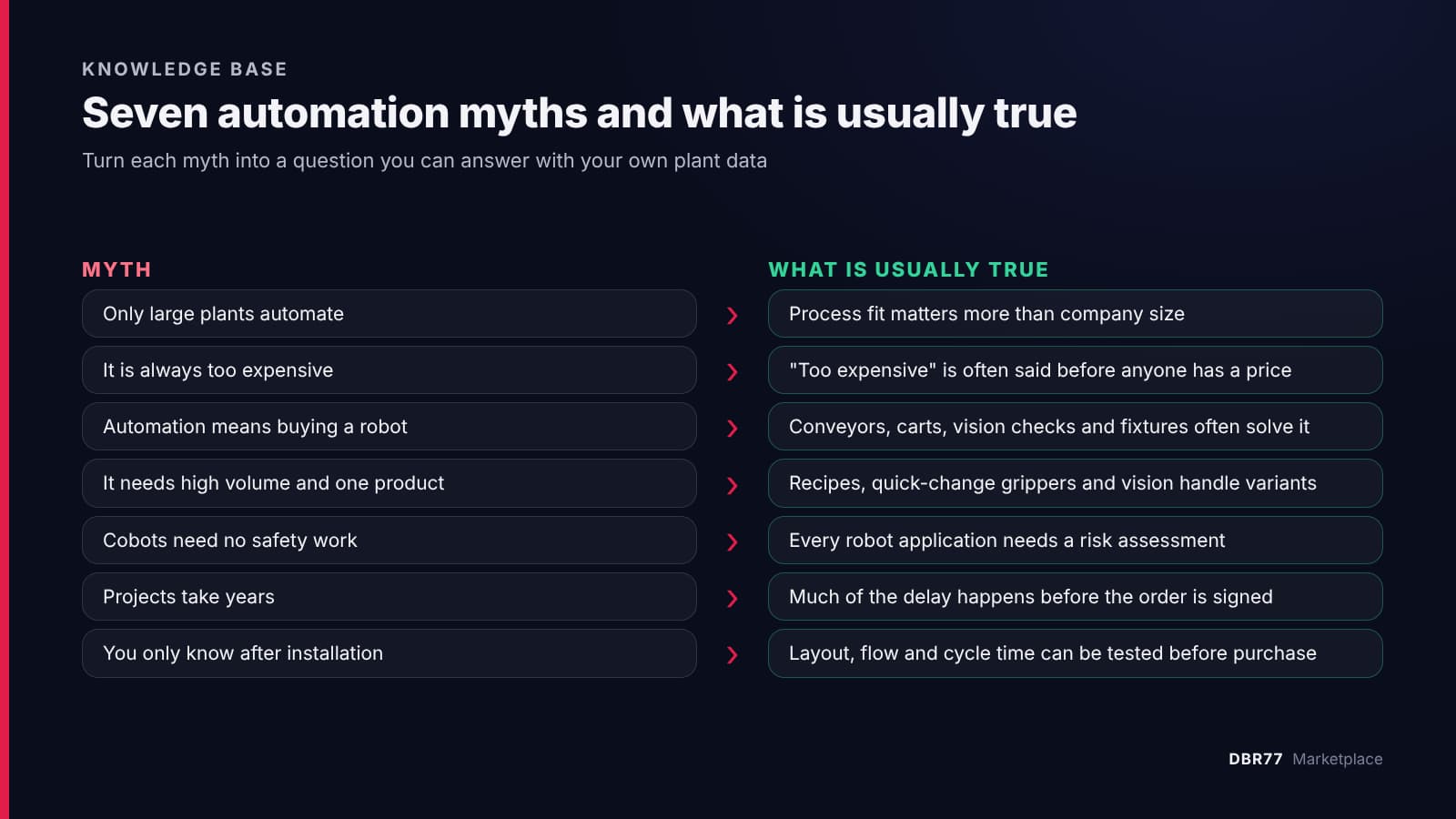
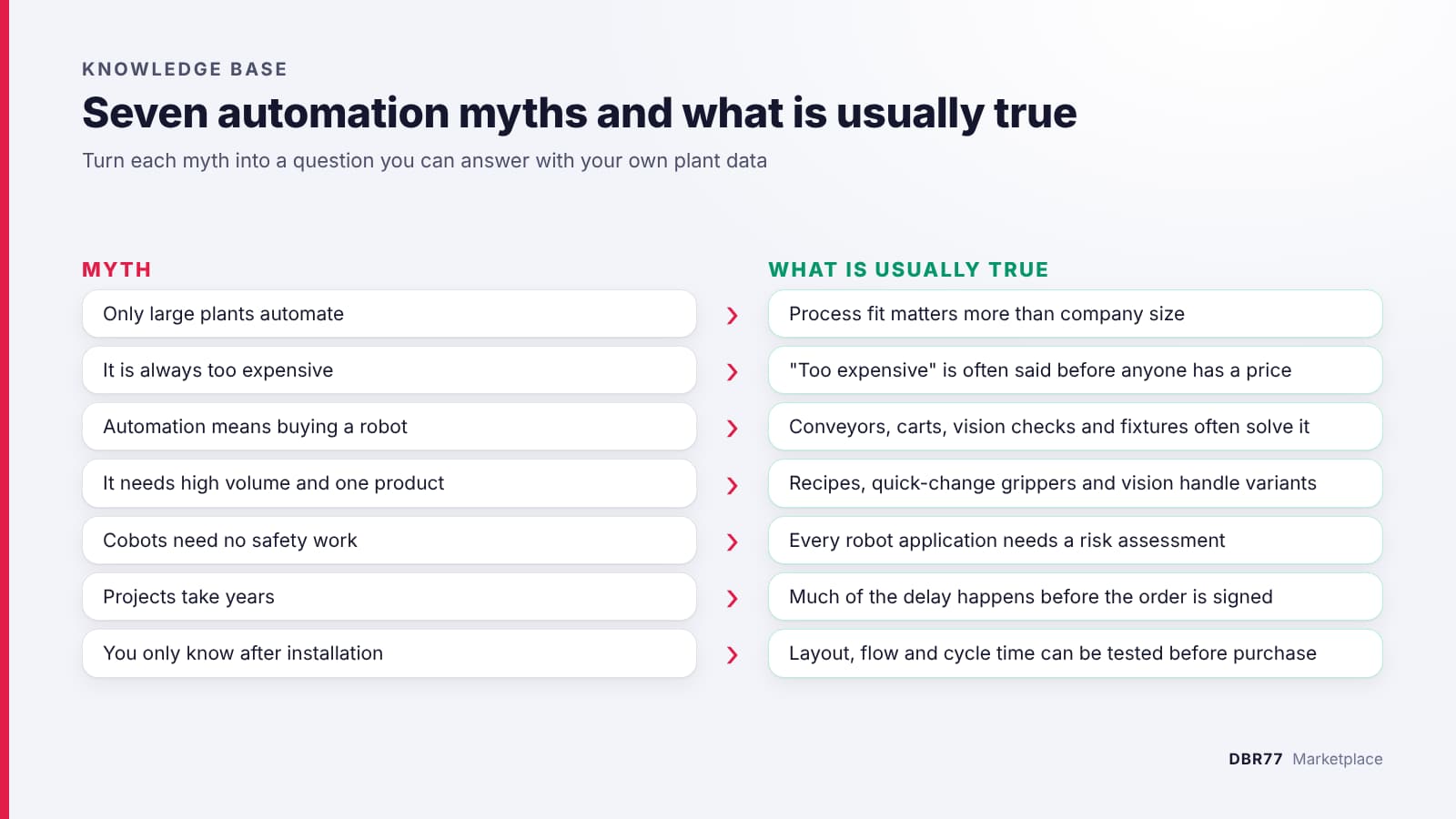
The seven myths at a glance
| Myth | What is usually true | What to check in your plant |
|---|---|---|
| 1. Only large plants automate | Process fit matters more than company size | One station with steady volume and a clear bottleneck |
| 2. It is always too expensive | "Too expensive" is often said before anyone has a price | Full cost of the manual station versus real offers |
| 3. Automation means buying a robot | Conveyors, carts, vision checks and fixtures often solve the problem | The task, not the equipment type |
| 4. It needs high volume and one product | Recipes, quick-change grippers and vision handle variants, within limits | Number of variants and changeovers per shift |
| 5. Cobots need no safety work | Every robot application needs a risk assessment | Who does the risk assessment and what is in the price |
| 6. Projects take years | Much of the delay happens before the order is signed | Time from idea to signed order versus build time |
| 7. You only know if it works after installation | Layout, flow and cycle time can be tested before purchase | Whether a simulation or a concept phase fits the project |
Myths about size and money
Myth 1 is that only large plants automate. Large plants do automate more, but automation is bought station by station, and a packing line in a 300-person plant has the same physics as one in a 3,000-person plant: cases per minute, case weight, pallet pattern, shifts. If a station runs steady volume on two or three shifts and holds up the line on peak days, it is a candidate. What a mid-size plant usually lacks is experience in buying automation, and a written brief with comparable offers makes up for much of it.
Myth 2 is that automation is always too expensive. Sometimes the numbers do not work, but "too expensive" often comes before anyone has written a brief or received an offer. The team compares a guessed price for a robot cell with one operator's wage, and the cell loses. That comparison leaves out most of what the manual station costs (overtime, turnover, injuries, quality losses, lost capacity), as shown in The Hidden Cost of Manual Processes in Manufacturing. It also leaves out what the cell costs beyond its price. Compare full cost with full cost, using real offers.
Illustrative example: at a management meeting, someone says "a palletizing robot costs half a million" and the idea is dropped. Nobody has written down cases per hour or asked a supplier. The figure came from a trade show chat about a different application. The plant dropped the idea on the strength of a number nobody had checked.
Myths about what automation is
Myth 3 is that automation means buying a robot. A robot arm is one tool among many. Plenty of problems are solved better by something simpler: a conveyor with a buffer zone, a driverless cart on a fixed route, a vision check at the end of a line, a fixture that removes a manual alignment step, or machine data that shows why a line stops. Starting with "we need a robot" makes suppliers quote hardware. Starting with the task ("move cases from two lines to one pallet station at line speed, on three shifts") lets them propose the right kind of solution, which may or may not include a robot.
Myth 4 is that automation only pays off with high volume and one product. That was truer when every product change meant retooling by hand. Today, recipe-based programs, quick-change grippers and vision systems that locate parts let one cell handle several variants. There are limits: every changeover takes time, and a cell designed for a handful of variants will not cope with hundreds. Check what has to flex: variants, changeovers per shift, new products per year and peak volume. If the product range changes every week and nobody can describe it, read When Not to Automate (and When Waiting Is Right).
Test the myth against real offers
Describe one station on DBR77 Marketplace and see what integrators propose, in one comparable format. Free for manufacturers.
Myths about safety and time
Myth 5 is that collaborative robots need no safety work. Cobots limit force and speed, so in many applications they can work near people without a fence. That leads to a risky shortcut: "it's a cobot, so it's safe." Safety is assessed for the whole application, including the tool and the task. In an A3 article on cobot safety, experts stress that a proper risk assessment is still needed before deployment, and that a cobot holding a knife and waving it in the air is not a collaborative application. The safety standard for robot applications and cells, ISO 10218-2, was revised in 2025.
The opposite myth exists too: "every robot needs a big cage, and we have no floor space." Fences, light curtains, area scanners and speed and separation monitoring are all options, and the risk assessment decides which fits. Ask each supplier who does the risk assessment and which safety equipment is in the price.
Myth 6 is that automation projects take years. Some do, especially large lines with many interfaces. Often, though, the longest phase comes before design starts: the gap between "we should automate this" and a signed order, filled with unclear briefs, offers that answer different questions and approval rounds that reopen the scope. Ask suppliers to split their lead time into design, build, FAT, installation, SAT and ramp-up, and you will see what the project itself takes.
Myth 7 and how to test any myth in your plant
Myth 7 is that you only find out if it works after installation. A layout drawing and a spreadsheet could not show whether a cart would block an aisle at shift change, or whether a cell would hold cycle time with the real product mix. Today a simulation of layout and material flow can answer those questions before a purchase order; Before You Buy a Robot, Simulate It First shows how.
To test any myth, ask for the number behind it. "Too small" becomes: which station runs steady volume on two or more shifts? "Too expensive" becomes: what does that station cost per year in full, and what do real offers say? "Not ready" becomes: what exactly is missing, an owner, baseline numbers or a stable process? If the answers point to one station, the next step is How to Choose the First Process to Automate. If they show the process is not stable yet, waiting may be the right call.
How DBR77 Marketplace helps
Most of these myths survive because nobody has asked suppliers a concrete question. On DBR77 Marketplace, you describe one station as a Technology Challenge in a guided form (requirements, budget, files and operational assumptions such as shifts, operators and cycle time), and DBR77 experts review it before it goes live. Integrators first answer with concepts, so you see whether they propose a robot, a conveyor or something simpler, and then with offers that state scope, conditions and costs in a standardized format, ready to set against the full cost of the manual station.
FAQ
Is automation realistic for a plant with 200 employees?
Yes, if there is a station with steady volume, repetitive work and a clear effect on output, quality or safety. Start with one station.
Do collaborative robots remove the need for safety fencing?
Sometimes, but only if the risk assessment shows it. A cobot that has to run slowly to stay safe may also miss the target cycle time, so check both before you choose.
How can we tell a myth from a real limit?
A real limit has a number: a budget ceiling, a floor-space limit, a cycle time no concept can reach. A myth usually does not. If nobody can name the number, write a brief and ask suppliers.
Conclusion
If one of these myths has stopped a project in your plant, take the station it was about and write down its volume, shifts, variants and full annual cost. Send the same brief to several suppliers and compare full cost with full cost; a limit that still holds after that, such as a budget ceiling or a cycle time no concept can reach, is a real one.
Replace assumptions with offers
Post a Technology Challenge on DBR77 Marketplace, or talk to our team about which station to describe first.
Post your Technology Challenge · Contact the Marketplace team
Sources
- McKinsey & Company, Unlocking the industrial potential of robotics and automation, 2023 (survey conducted in August 2022)
- International Federation of Robotics, Global Robot Demand in Factories Doubles Over 10 Years, 2025
- Association for Advancing Automation (A3), Five Key Collaborative Robot Safety Concepts, 2022
- ISO, ISO 10218-2:2025 Robotics: Safety requirements, Part 2: Industrial robot applications and robot cells, 2025