When Not to Automate (and When Waiting Is Right)
By DBR77 Team · Published · Updated
Do not automate a process that is not stable yet: the method changes from shift to shift, scrap and rework are high, parts arrive in an unpredictable state, or nobody can say what the current cycle time really is. Also hold off when the product or volume will change within the payback period, when a simpler fix such as a better layout or a lift aid would solve the problem, or when nobody owns the project. In those cases a robot cell locks today's problem into expensive hardware. Waiting is the right decision when it is an active one: a written list of what must be fixed, an owner and a date to decide again.
Why automation makes a weak process worse
A manual process hides a lot of variation. An experienced operator turns a part that arrives the wrong way round, sorts out a mixed bin, wipes off a burr and keeps going. Nobody records any of it. A robot cannot do that unless someone designed it to. It needs parts presented the same way, in the same place, within known tolerances.
That is why the NIST Manufacturing Extension Partnership, in its Automation 101 guide, recommends mapping processes and eliminating waste before considering automation, and warns that if a process is not streamlined, "automation could simply amplify those inefficiencies."
Illustrative example: a plant wants a robot to unload parts from an injection molding machine and place them in boxes. During the supplier visit it turns out that the mold has two cavities that produce slightly different parts, that short shots are sorted by hand, and that the box type changes depending on the customer. None of this is in the request. The supplier either quotes a much more complex cell or quotes a simple one that will stop several times a shift. Fixing the mold and agreeing one box standard would have made both the problem and the cell smaller.
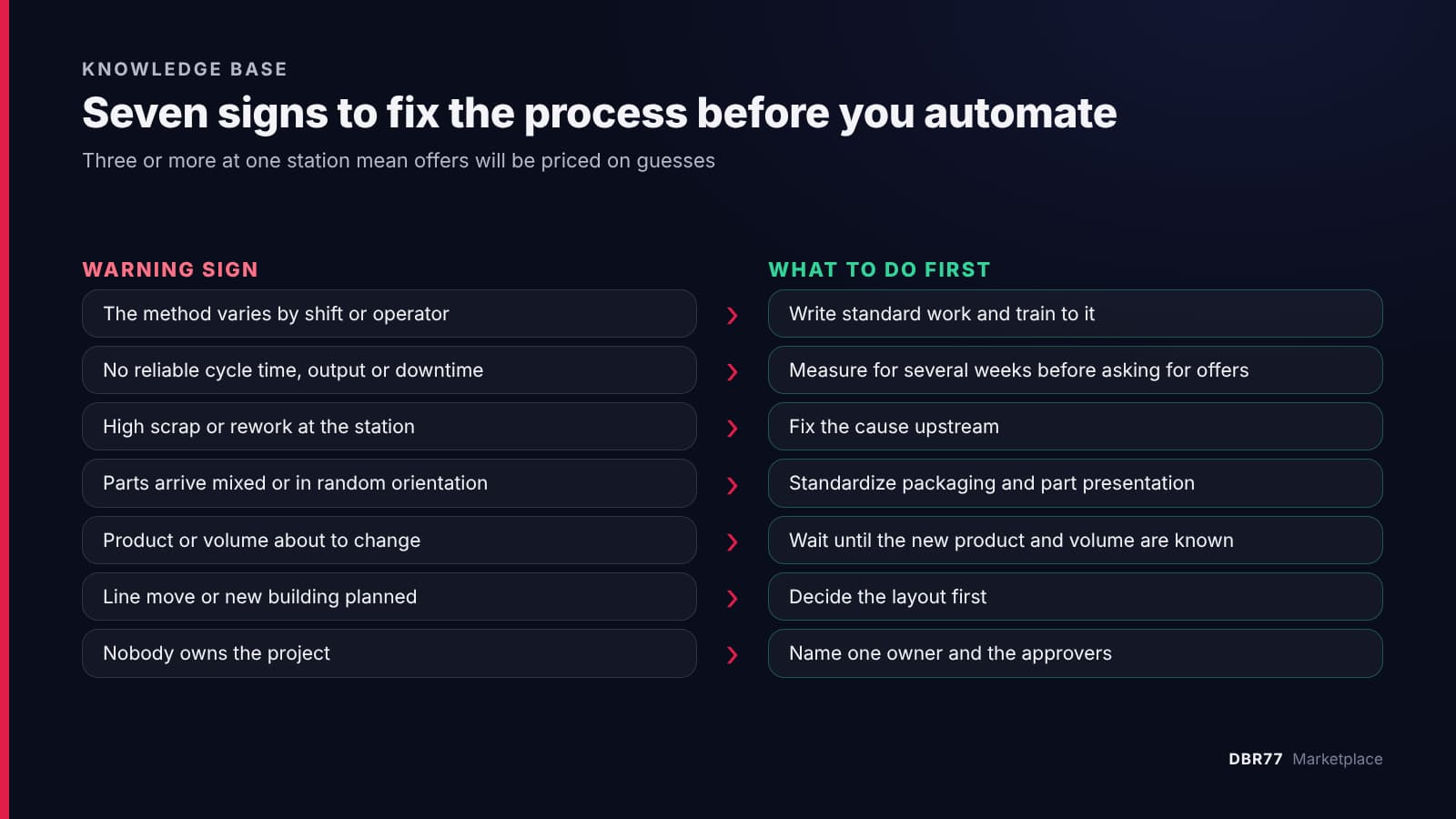
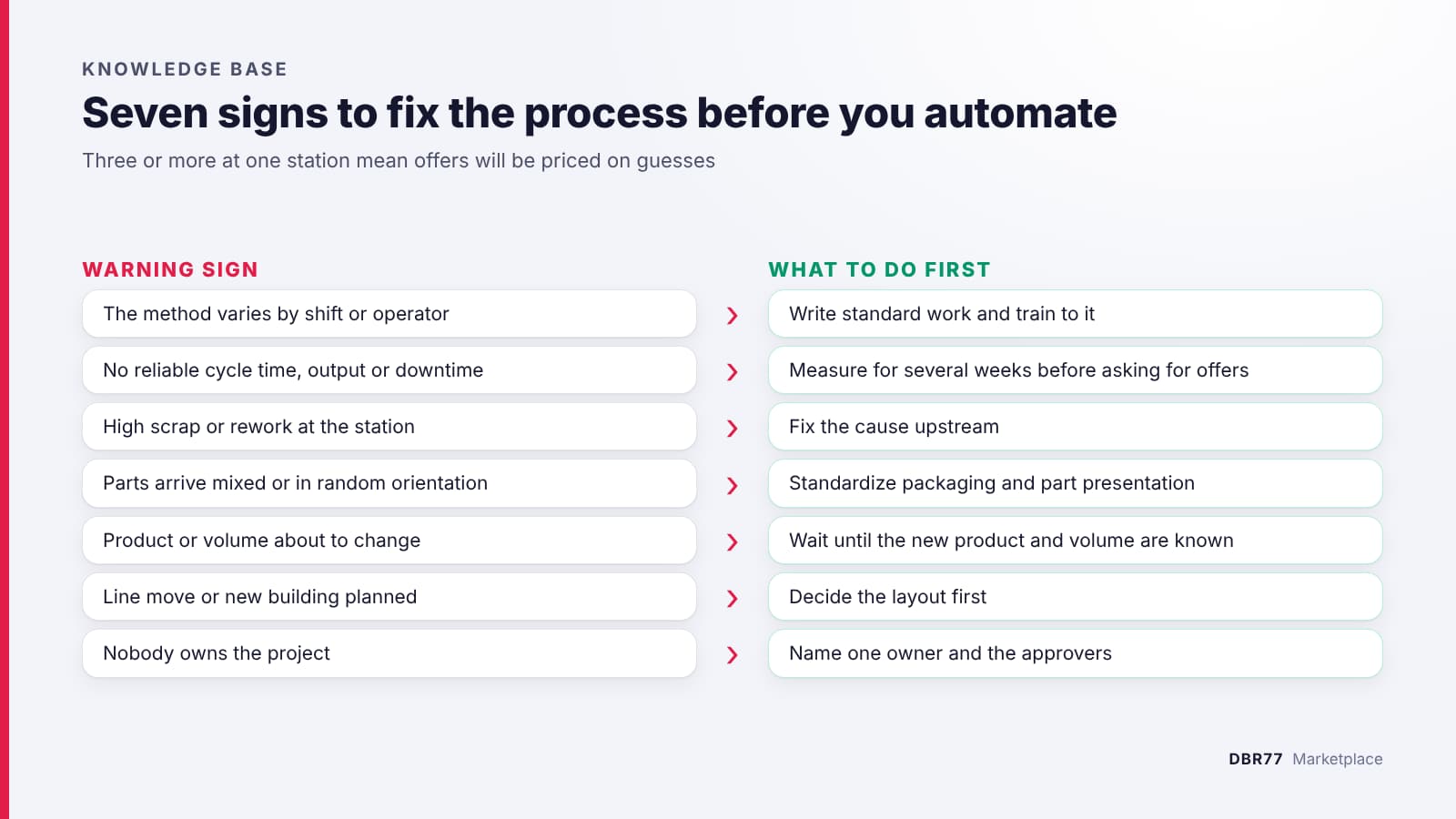
Seven signs you should fix the process first
| Sign | What you see on the floor | What to do first |
|---|---|---|
| 1. The method varies | Each shift or operator does the job differently | Write standard work and train to it |
| 2. No baseline | Nobody can give cycle time, output per shift or downtime with confidence | Measure for several weeks before asking for offers |
| 3. High scrap or rework | Parts are sorted, reworked or rejected at the station | Fix the cause upstream |
| 4. Irregular input | Parts arrive mixed, in random orientation or in changing containers | Standardize packaging and part presentation |
| 5. Product or volume about to change | Redesign, end of life or a new customer is coming | Wait until the new product and volume are known |
| 6. Layout about to change | A line move, extension or new building is planned | Decide the layout first |
| 7. Nobody owns it | "Operations should drive it", "engineering should drive it" | Name one owner and the approvers |
One sign is usually something to solve inside the project. Three or more at the same station mean the project will be priced on guesses, and the guesses will come back as change orders.
The baseline matters most. Without it you cannot write a target cycle time, you cannot judge the offers and you cannot prove the result at acceptance. If the station has machines with controllers, a few weeks of machine data often gives a better baseline than a stopwatch study; The First 30 Days of IoT in a Brownfield Factory shows how to collect it.
When a simpler fix does the job
Some problems that start as "we need a robot" are solved better and faster without one.
Layout and flow. If operators walk a long way to fetch material, or carts block the aisle, the fix may be a new layout, a supermarket next to the line or a fixed replenishment route.
Standard work and fixtures. If quality depends on how carefully a part is aligned, a simple fixture or poka-yoke may remove the problem at a fraction of the cost of a vision-guided robot.
Ergonomic aids. If the main reason is strain, look at lift assists, vacuum lifters, height-adjustable tables or pallet turntables. OSHA notes that work-related musculoskeletal disorders are among the most frequently reported causes of lost or restricted work time, and that there are many possible solutions to reduce or eliminate them, automation being only one.
A simple fix can also be a first step. Stabilize the station now, measure it for a few months, and automate later with a much clearer brief.
Process stable and measured?
Then it is ready for a Technology Challenge on DBR77 Marketplace. Describe it once and compare integrator offers in one format. Free for manufacturers.
When the timing is wrong
A stable process can still be a poor candidate if the product, the volume or the building is about to change.
A cell is designed around a product: its size, weight, packaging and variants. If a redesign or a new packaging format is planned in the next year, ask the suppliers how much of the cell would survive the change. If the answer is "not much," wait or design for the new product.
A cell sized for a contract that may not be renewed is a risk, so compare the payback period with the time you are confident the volume will stay. And if the line will move to another hall, or a new building is planned, automating the old layout often means paying twice.
Illustrative example: a plant plans to automate end-of-line packing for a product family that will move to a new carton size in nine months. The team asks suppliers to quote for the new carton and to install after the change. The order is placed now and nothing has to be rebuilt later.
How to wait without drifting
"Let's revisit next year" with no list and no owner usually means the topic returns every quarter and nothing changes in between. Write the deferral down in four parts:
- The reason: which of the signs above applies, in one or two sentences.
- What must be true to restart, for example standard work in place on all shifts, scrap below an agreed level, eight weeks of baseline data, new carton size confirmed.
- One owner responsible for closing the list.
- The date when the plant decides again, whatever the status.
Meanwhile, put a price on the wait. The monthly cost of the manual station, as shown in The Hidden Cost of Manual Processes in Manufacturing, tells management how much the delay costs and keeps the restart date honest.
If every item on the list is closed and the project still does not start, look for the cause among the beliefs in 7 Myths About Industrial Automation. Once the conditions are met, use How to Choose the First Process to Automate to pick the station.
How DBR77 Marketplace helps
A Technology Challenge on DBR77 Marketplace is the step after the restart list is closed. The guided form starts with the maturity of the project, which decides the required fields, and goes on to requirements, budget and operational assumptions, so a step you cannot fill in points to a gap to close before you publish. DBR77 experts review the challenge before it goes live.
FAQ
Is it ever right to automate an unstable process?
Sometimes, if automation removes the cause of the instability, for example when manual handling damages parts. Then the brief must describe the variation openly, so suppliers can design for it instead of discovering it at commissioning.
How long should we measure before asking for offers?
Long enough to cover normal variation: all shifts, the main product variants and at least one changeover pattern. For many stations that means several weeks. Use machine data where it exists.
Does waiting send the wrong signal to management?
Not if the deferral is written down with a reason, a restart list, an owner and a date. A vague "not yet" is what costs credibility.
Conclusion
Check the station against the seven signs before you ask for offers. If three or more apply, treat fixing the process as the first phase of the project and write down why you are waiting, what must change, who owns it and when you will decide again. If one applies, solve it inside the project and start describing the station for suppliers.
Ready when your process is
Post a Technology Challenge on DBR77 Marketplace when the station is ready, or talk to our team about what to prepare first.
Post your Technology Challenge · Contact the Marketplace team
Sources
- NIST Manufacturing Extension Partnership, Automation 101: How to Plan for a Successful Implementation, 2024
- Occupational Safety and Health Administration (OSHA), Ergonomics, accessed 2026