Why Most Automation Projects Never Start
By DBR77 Team · Published · Updated
Most automation projects never start because the plant never turns a shared complaint into a decision someone can make. The technology usually exists. What is missing is a written challenge with numbers, one owner, offers that answer the same question, a first step small enough to approve, and a price on waiting. Fix those five things and a project that has been "under discussion" for a year can reach a supplier decision instead of another round of meetings.
What a stalled automation project looks like
Illustrative example: a mid-size food plant palletizes cases by hand at the end of two packing lines, on two shifts. Everyone agrees it should be automated. The work is heavy, two operators left last year, and on peak days the lines wait for the pallet station.
Engineering calls two integrators it knows. Both visit, both send proposals. One quotes a robot cell for one line. The other quotes a cell shared by both lines, with a conveyor. One includes safety fencing and a stretch wrapper. The other lists them as options. The prices differ by a factor of two, and nobody can say which offer is right, because nobody wrote down what the job was.
Six months later the project is still on the agenda, and nothing has been ordered.
This pattern is common. In McKinsey's 2022 survey of industrial leaders, 71 percent named the capital cost of robots as a barrier, 61 percent named their company's lack of automation experience, and 42 percent said it was hard to find end-to-end solution providers. Budget and experience are real limits, but in most stalled projects they are symptoms of a weak buying process.
The five reasons automation projects stall
| Reason | What you hear in the meeting | What to do instead |
|---|---|---|
| The problem is not written down | "This area is too manual" | Describe one process with volumes, cycle time, products, shifts and constraints |
| Nobody owns the decision | "Operations should drive it" | Name one owner and the people who approve |
| Offers cannot be compared | "The prices are all over the place" | Send every supplier the same brief and share every answer with all of them |
| The first step is too big | "If we automate, let's do the whole hall" | Start with one process that pays back on its own |
| Waiting looks free | "Let's revisit it next budget cycle" | Put a monthly cost on the manual process |
-
The problem is not written down. "Too manual" gives an integrator nothing to quote. A quote needs numbers: products and weights, units per hour, cycle time, shifts, floor space, connections to existing machines and IT, safety rules. Without them, each supplier fills the gaps with its own assumptions, and you receive five offers for five different projects. For the write-up itself, use How to Write an Automation Brief Integrators Can Quote.
-
Nobody owns the decision. Automation touches operations, maintenance, engineering, procurement, finance and safety. Each has a fair point of view: output, uptime, interfaces, price, payback, risk. When nobody owns the whole, every meeting reopens the question from a different side. One person has to own the brief, the timeline and the final recommendation, with named approvers.
-
Offers cannot be compared. When suppliers answer different questions, the buyer spends weeks translating PDFs. One supplier gets a clarification by phone that the others never hear. A scope change in week six makes the week-two quotes useless. Use one brief, one deadline, one list of questions and answers shared with every bidder, and one table for scope, exclusions, lead time and price.
-
The first step is too big. A plan to automate the whole hall needs board approval, a large budget and a team with experience the plant often does not have. Those are the barriers the McKinsey respondents named. One cell or one transport route is a decision a plant director can defend, and How to Choose the First Process to Automate shows how to pick it.
-
Waiting looks free. A manual process sends no invoice, so delay has no visible cost, yet it is paid for in overtime, temporary staff, turnover, lifting injuries and orders the line cannot take. Without a monthly number, the project keeps moving to next year. To put a figure on it, see The Hidden Cost of Manual Processes in Manufacturing.
Turn your automation idea into a challenge suppliers can quote
Describe one process on DBR77 Marketplace and receive offers from integrators in one comparable format. Free for manufacturers.
A real example: from internal need to supplier choice
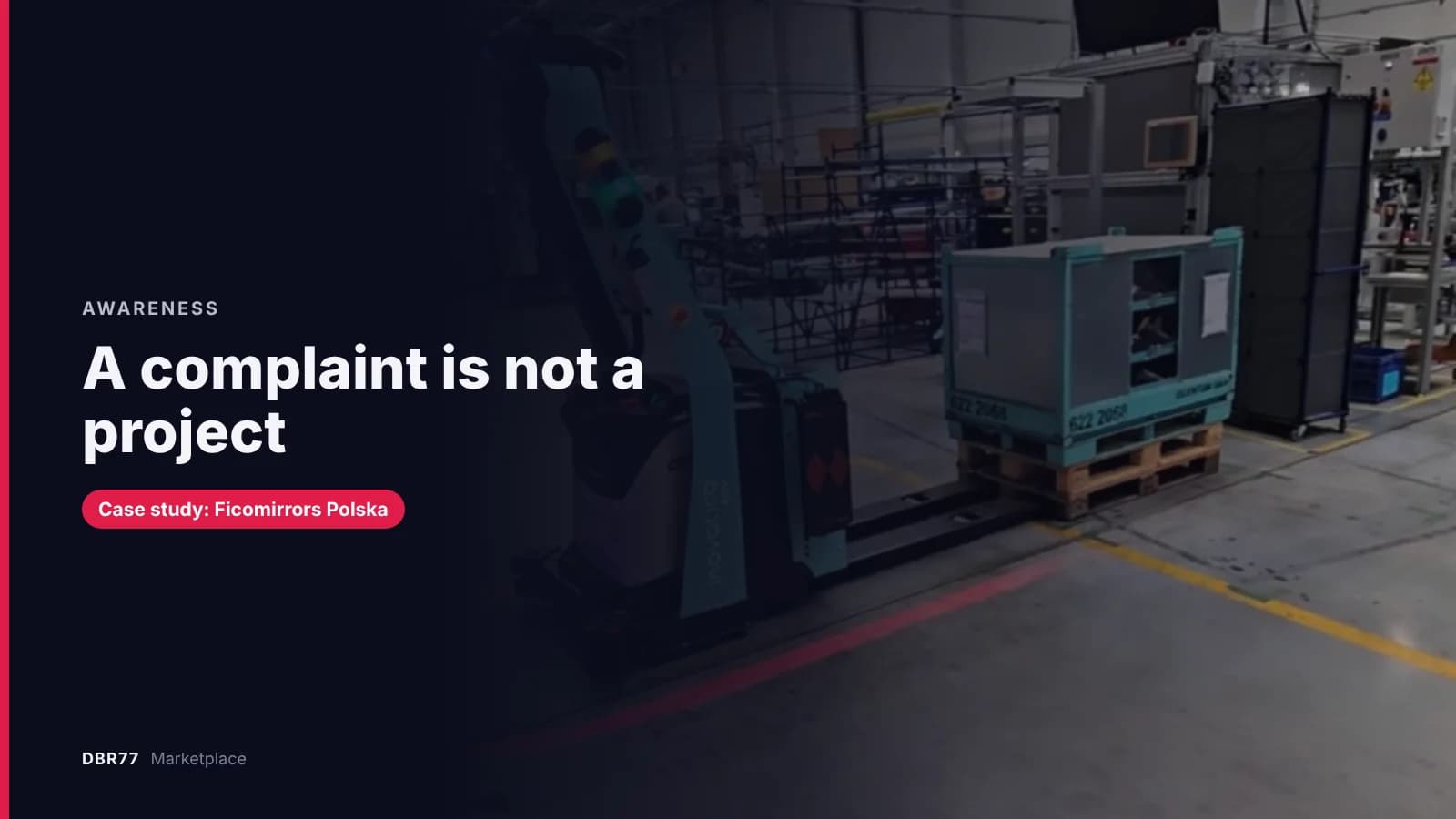
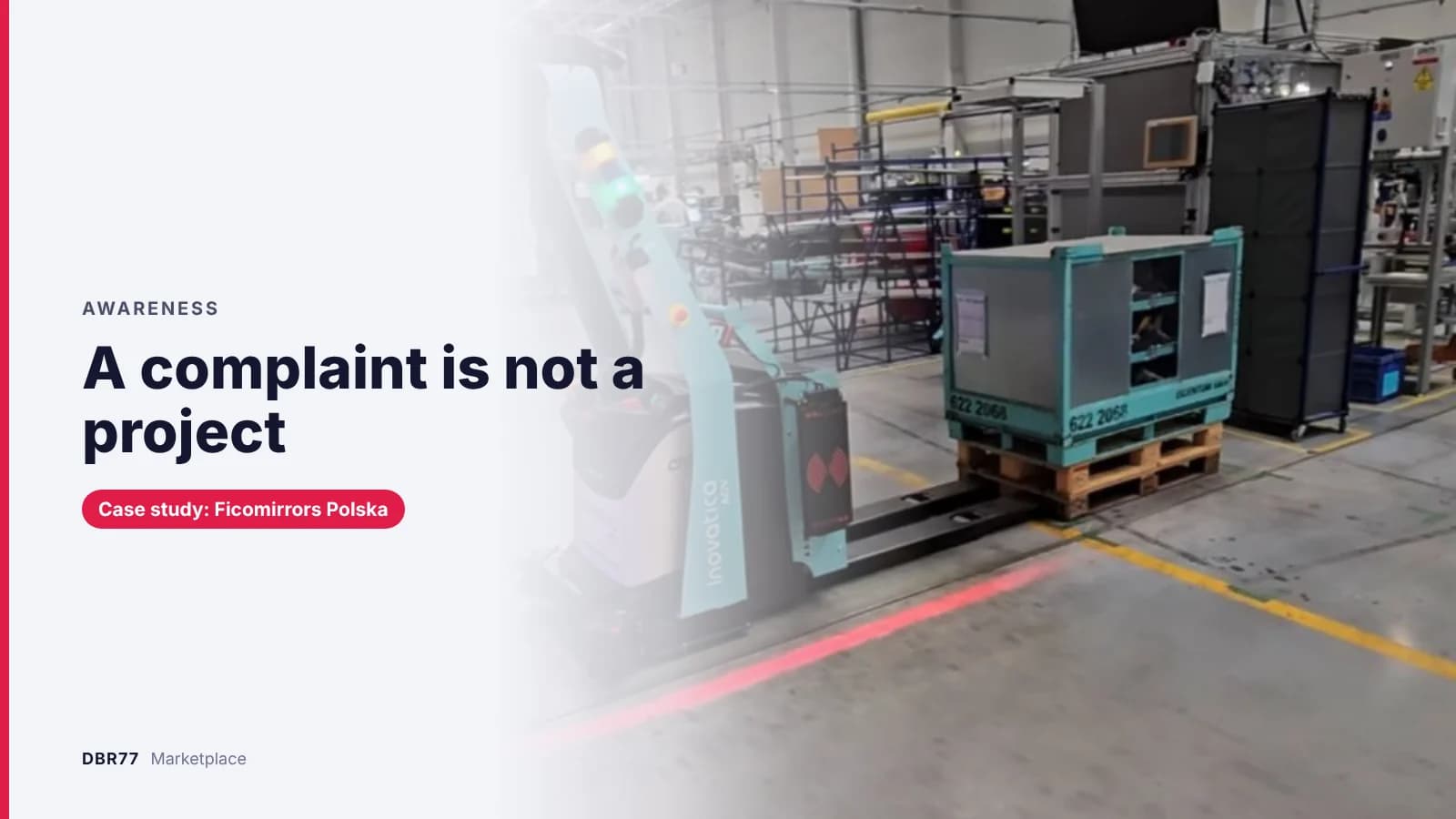
Ficomirrors Polska, a Tier-1 automotive supplier in the Ficosa group, had a clear operational problem. Internal transport between production lines and warehouse zones depended on manual operators being available. That caused downtime and uneven performance, and zones shared by people and machines needed high safety standards.
The plant published a Technology Challenge on DBR77 Marketplace with its requirements and budget: integration with the existing IT systems, pallets of up to 250 kg, and the highest safety standards in shared zones. Integrators answered in one standardized format, so the team could compare function, cost and system compatibility side by side.
The plant chose Inovatica AGV. The solution uses two autonomous forklifts connected to tablets at the production lines and to the master system, and it moves up to 13 pallets per hour in continuous mode. The full story is in the Ficomirrors case study.
Before it spoke to suppliers, the plant named one process, internal transport. It wrote hard limits: 250 kg, IT integration, safety in shared zones. It set a budget. Those three steps removed reasons 1, 3 and 4 from the table above.
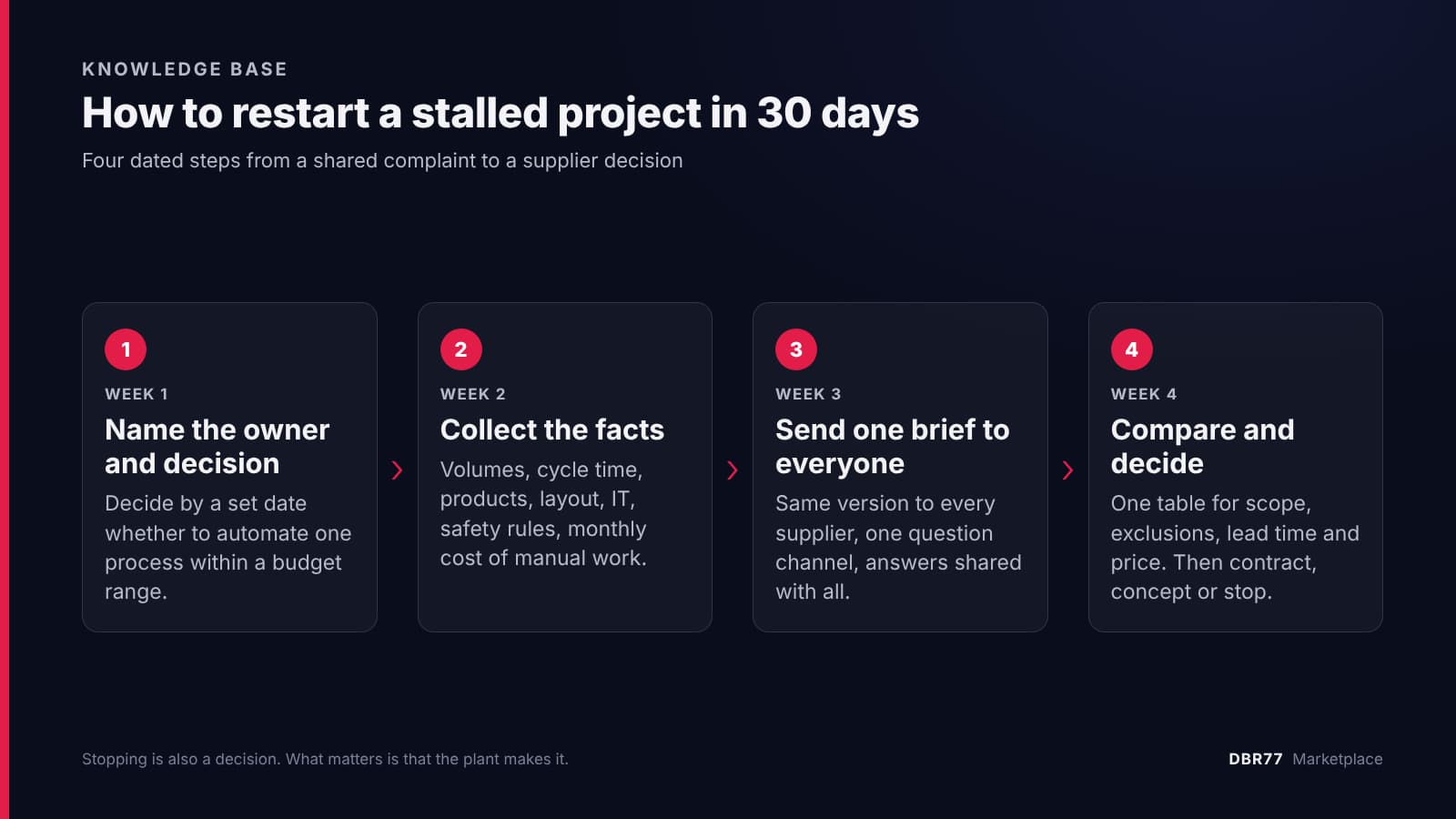
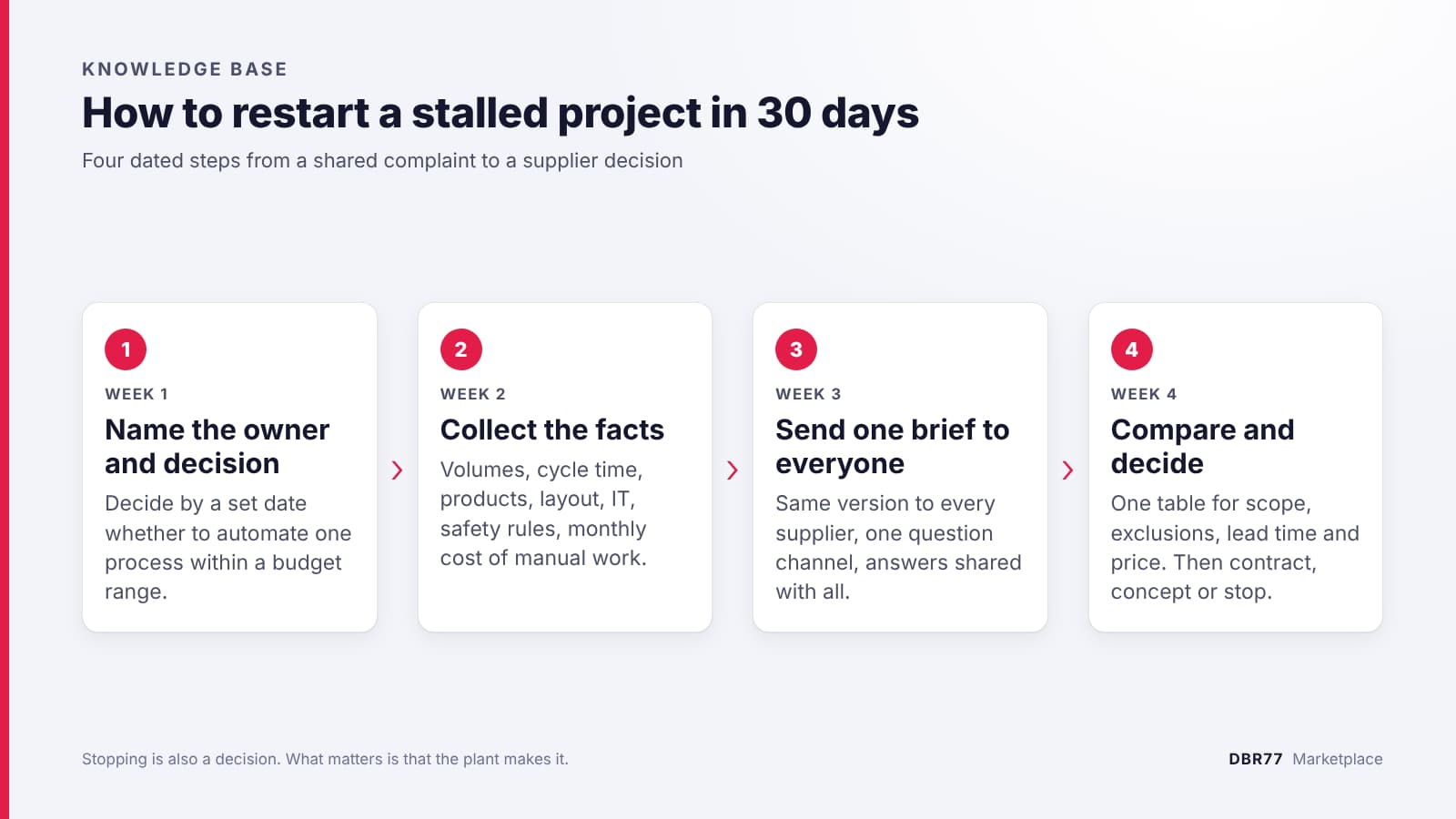
How to restart a stalled project in 30 days
Plan the restart week by week:
- Week 1: name the owner and the decision. Write one sentence: "By [date] we will decide whether to automate [process] within [budget range]." Name the approvers.
- Week 2: collect the facts. Volume per shift, cycle time, product sizes and weights, variants, floor space with a layout drawing, existing machines and controls, IT systems, safety rules, plus photos or short videos. Add the monthly cost of the manual process.
- Week 3: write the brief and send the same version to every supplier. Use one channel for questions and send every answer to all bidders.
- Week 4: compare and decide the next step. Put the offers in one table: scope, exclusions, assumptions, lead time, price, service. Shortlist two and ask follow-up questions. Then choose: contract, a paid concept phase, or stop.
Stopping is a valid outcome: some processes should be stabilized before they are automated, as explained in When Not to Automate (and When Waiting Is Right). Whichever way the plant decides, the topic stops coming back at every quarterly review.
How DBR77 Marketplace helps
DBR77 Marketplace is built for weeks 2 to 4 of this plan. The guided form asks for the facts you collect in week 2 (requirements, budget, files, operational assumptions), and DBR77 experts review the challenge before it goes live. Supplier questions go to a Q&A tab that every integrator can read, and offers come back in a standardized format with delivery time, warranty, payment terms, installation, training and support, ready for the week 4 table. Integrators and suppliers pay a commission on successful deals, and contracts are signed directly between the parties.
If you first want to check whether a new layout or material flow works at all, you can test it in DBR77 DT before you ask for offers.
FAQ
Is budget the main reason automation projects do not start?
It is the barrier named most often: 71 percent of respondents in McKinsey's 2022 survey cited the capital cost of robots. In practice, budget talks stall when nobody can say what the money buys. A written challenge with a clear scope turns "too expensive" into a number you can test.
What should be ready before we contact integrators?
One owner, one process, baseline numbers (volume, cycle time, products, shifts), hard limits (space, interfaces, safety) and a decision date. A budget range helps suppliers propose a solution of the right size.
How many suppliers should we ask for offers?
Enough to compare, few enough that you can answer each one properly. Many buyers aim for three to five serious offers. If you need more, the brief is usually too vague to filter suppliers. Shortlisting is covered in How to Shortlist and Check Automation Suppliers.
Conclusion
If your project has sat on the agenda for months, start with week 1 of the plan: name one owner and write the decision sentence with a date and a budget range. Then put a monthly cost on the manual process, so the approvers can weigh the price of waiting against the offers.
Get your automation project moving
Post a Technology Challenge on DBR77 Marketplace, or talk to our team about how to prepare it.
Post your Technology Challenge · Contact the Marketplace team
Sources
- McKinsey & Company, Unlocking the industrial potential of robotics and automation, 2023 (survey conducted in August 2022)
- DBR77, How DBR77 Marketplace stabilized logistics for a Tier-1 automotive supplier (Ficomirrors), 2026