How to Compare Automation Offers Side by Side
By DBR77 Team · Published · Updated
Automation offers become comparable when you stop reading them as documents and fill the same table for each one. Before you look at price, write down for every offer what is included, what is excluded, which assumptions the supplier made, how performance will be proven and who owns each interface. Then add the cost of everything an offer leaves out, so each line shows the price of the same finished project. Send every question to all bidders and every answer back to all of them. Only then does the lowest number mean something.
Why offers for the same job are hard to compare
Illustrative example: a plant asks four integrators to automate case palletizing at the end of one packing line. One quotes a robot cell with fencing, a stretch wrapper and an operator panel. One quotes the robot and gripper and lists fencing and the wrapper as options. One assumes the plant's maintenance team will extend the infeed conveyor. One offers a collaborative robot without fencing, at a lower case rate than the plant asked for.
The prices are far apart because the buyer is looking at four different projects. Each supplier filled the gaps in the brief with its own assumptions. A tight brief prevents much of this; How to Write an Automation Brief Integrators Can Quote shows how to write one.
Delivery models differ too. In McKinsey's 2022 survey of industrial companies, 55 percent would prefer a system integrator to act as a single point of contact, and 42 percent found it hard to find end-to-end solution providers. Some offers cover the full cell, others only the robot package.
Build one comparison table before you read the prices
Make the table first, with the same rows for every offer. Where an offer is silent, write "not stated": that is a question for the supplier, not a zero.
| Row | What to record for each offer | Warning sign |
|---|---|---|
| Scope boundary | Where supply starts and ends: infeed, robot, gripper, outfeed, fencing, wrapper | Boundary shown only on a sketch |
| Exclusions | Options, items "by others" or "by customer" | "Customer to provide" with no detail |
| Assumptions | Products, weights, rate, variants, shifts, utilities | Assumptions that differ from your brief |
| Performance | Cycle time or rate, for which product mix | A rate without the mix |
| Proof | What is tested at FAT and SAT, with which samples | "Standard practice" |
| Interfaces | Line PLC, upstream machines, MES/ERP, remote access, owner of each | Interface with no owner |
| Safety | Risk assessment, safety concept, validation, CE documentation | Safety "by customer" |
| Schedule | Lead time, site time, shutdown windows | Lead time with no start condition |
| Price structure | Fixed price, day-rate items, options | One total, no breakdown |
| After start-up | Training, documentation, spare parts, warranty start | Warranty starting at shipment |
Watch the safety row. ISO 10218-2:2025, the safety standard for robot applications and robot cells, covers the whole cell through integration, commissioning, operation and maintenance. "Safety by customer" moves part of that work back to you. For driverless transport the reference is ISO 3691-4:2023.
Do the first pass without the price column. Teams that see prices first tend to read the cheapest offer generously and the rest critically.
Normalize the scope: compare the price to complete
Once the table is filled, the exclusions row becomes a cost list. For each offer, add what the plant would still have to buy, build or do itself to get a working station. That is the price to complete.
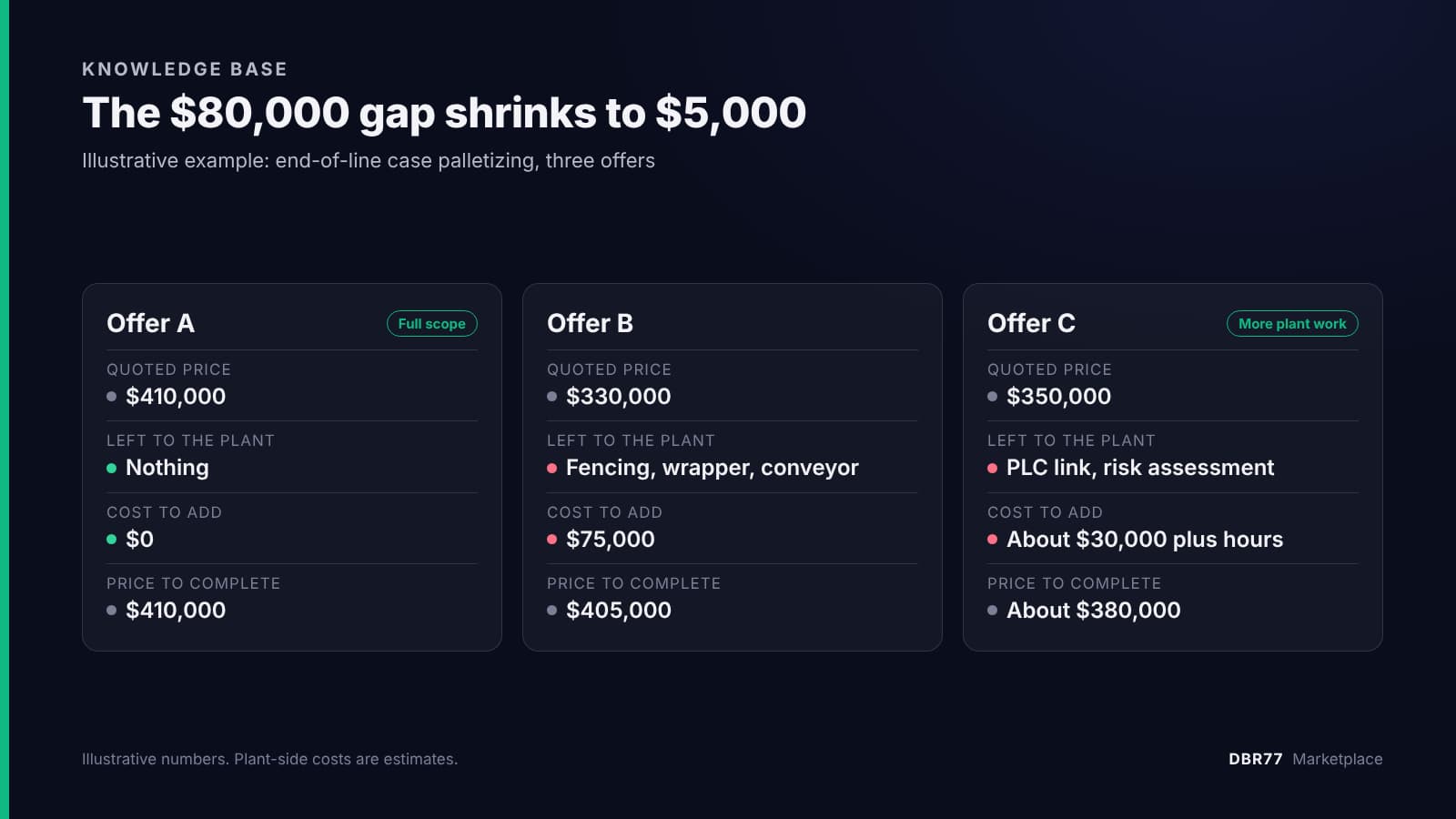
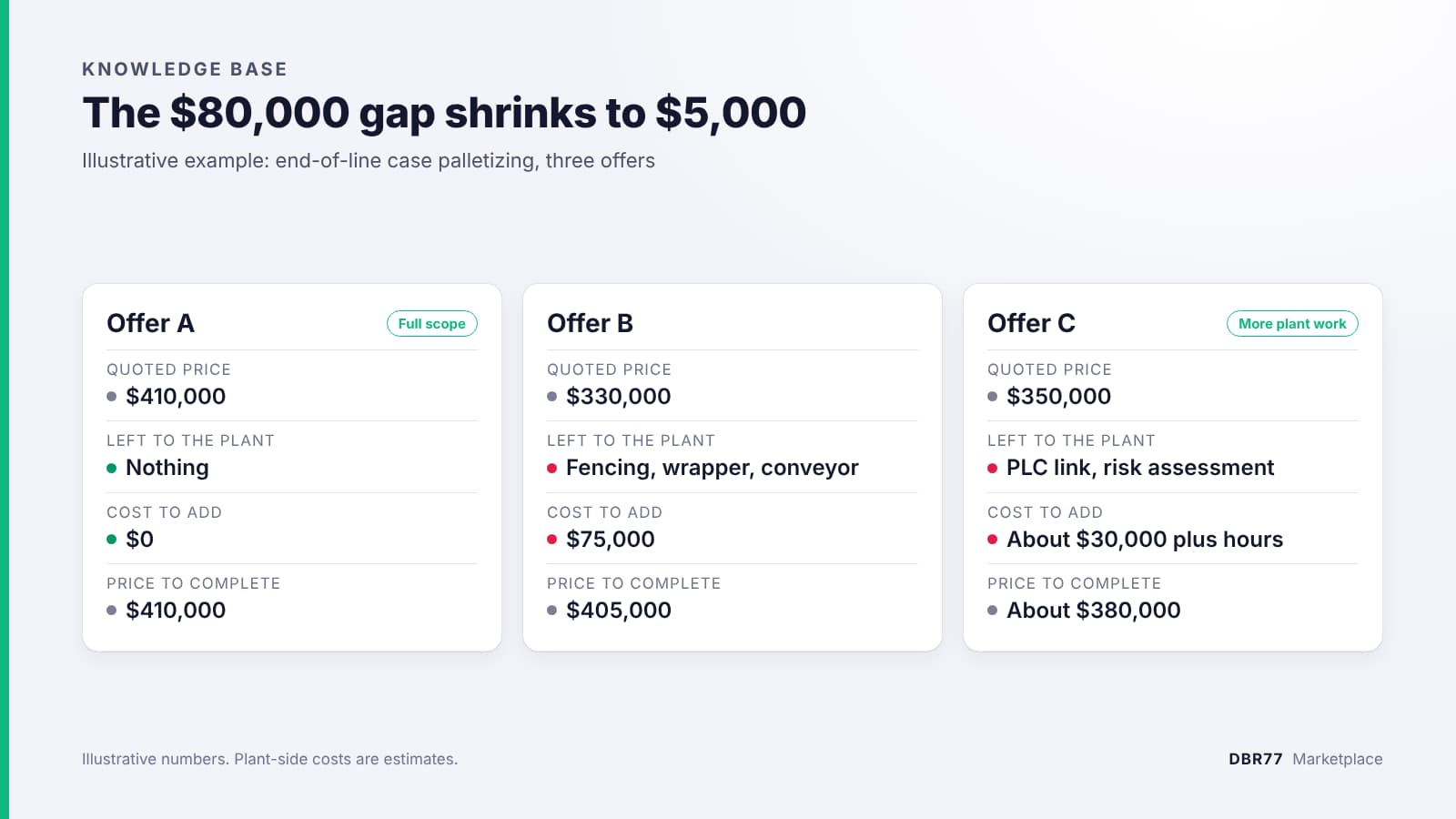
Illustrative example, continuing the palletizing case (made-up numbers to show the method):
- Offer A: $410,000 including fencing, wrapper and training. Price to complete: $410,000.
- Offer B: $330,000. Fencing and wrapper are options at $55,000, and the plant must modify the conveyor (estimate $20,000). Price to complete: $405,000.
- Offer C: $350,000. The plant supplies the PLC interface and the risk assessment (estimate $30,000 plus internal hours). Price to complete: about $380,000, with more work and interface risk on the plant side.
The $80,000 gap between A and B shrinks to $5,000. Offer C may still win, but the team now knows it buys a lower price with more of its own work.
This step is about scope only. For energy, maintenance and spare parts over ten years, use The Real Cost of Automation: TCO Beyond the Quote. Payment terms, warranty length and leasing are compared in How to Compare Automation Commercial Models, Not Just Prices.
Get offers that answer the same question
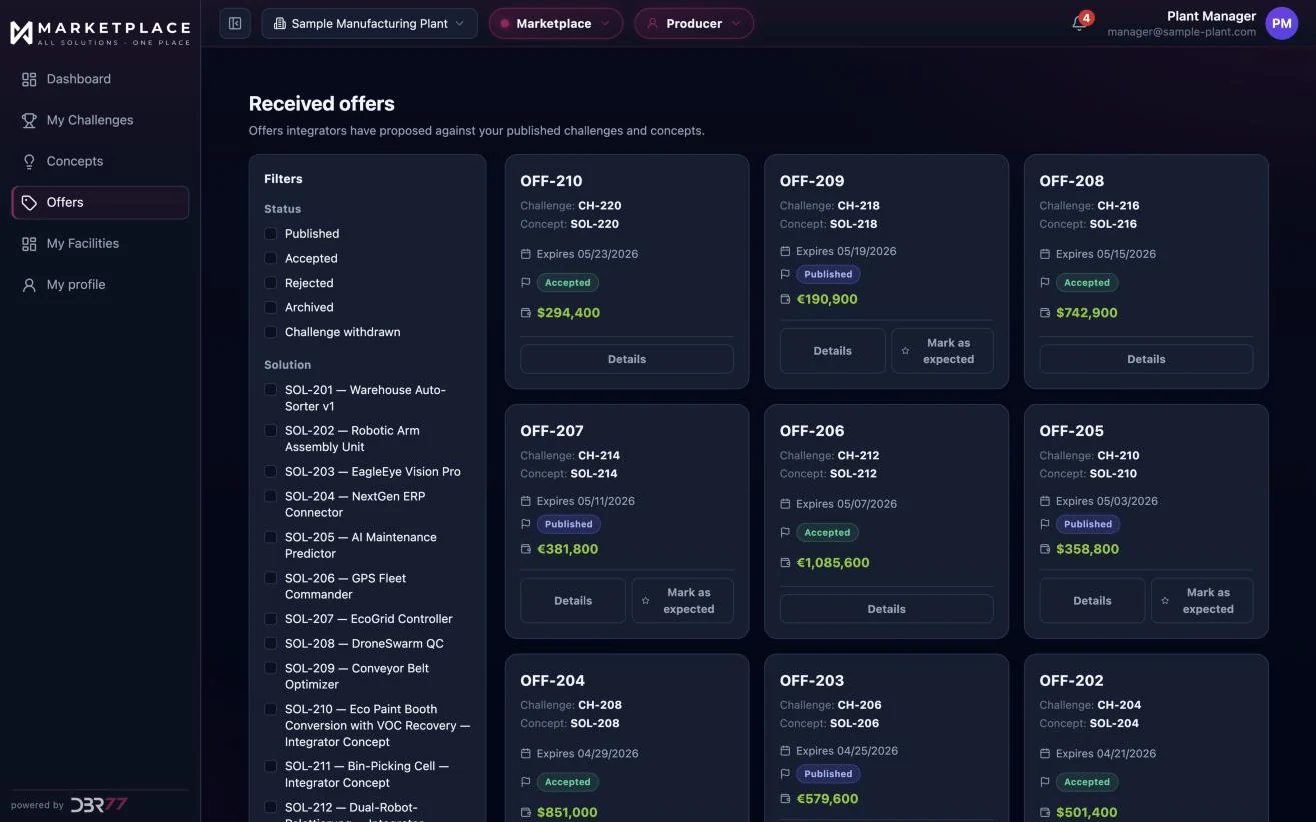
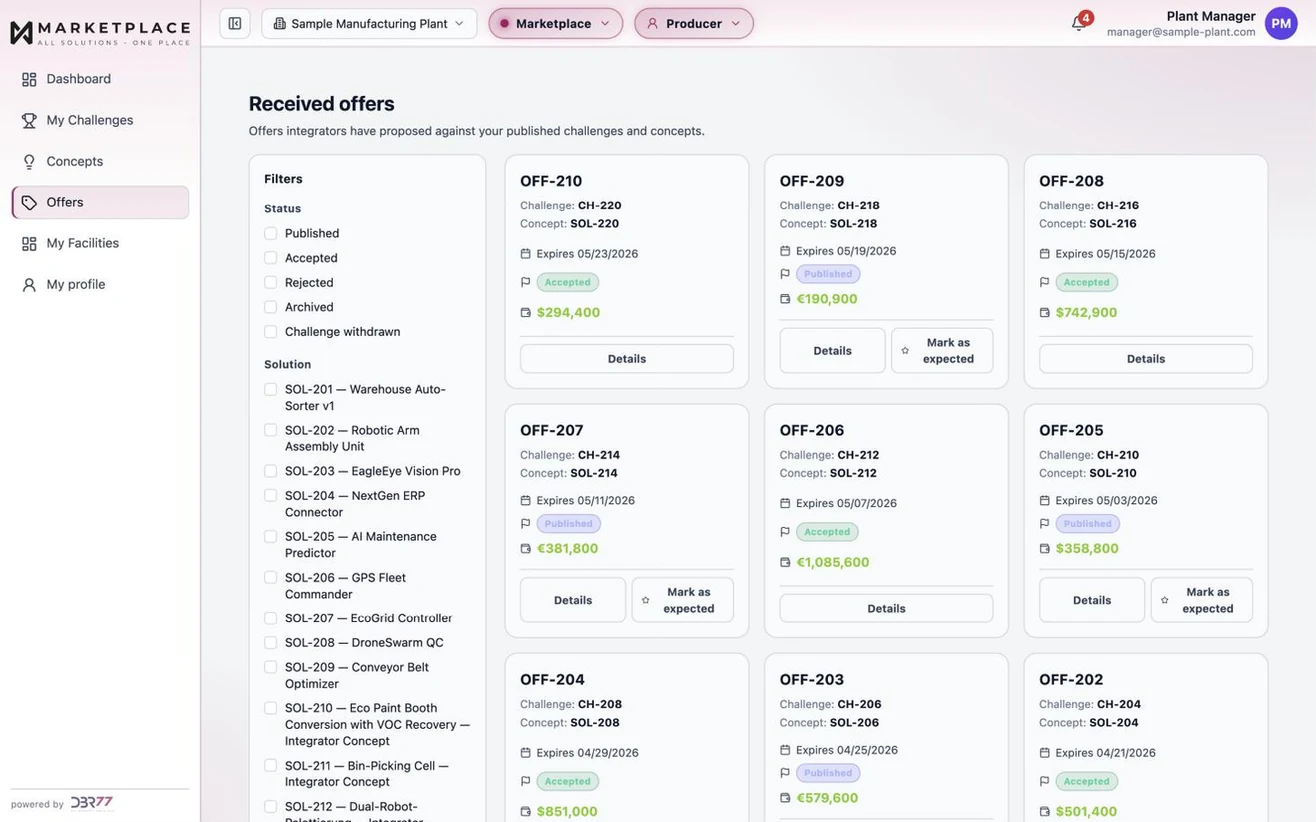
On DBR77 Marketplace, integrators submit offers in one standardized format, so scope, assumptions and exclusions line up field by field. Free for manufacturers.
Clarifying questions that expose the real differences
The table will show gaps. Close them with the same written questions to every bidder:
- Which products, weights and variants is your rate based on, and what happens with the worst-case product?
- What exactly is excluded, and what would each excluded item cost if you supplied it?
- Which of our assumptions did you change or not use?
- What will you demonstrate at FAT in your workshop and at SAT in our plant, against which criteria?
- Who owns the interfaces to the line PLC and MES/ERP, and what do you need from us, by when?
- What has to be true on our side for your lead time to hold?
Keep clarifications from breaking the comparison
If one supplier learns by phone that the line also runs a heavier product, it prices a different project, and the award becomes hard to defend. To prevent that:
- Take all questions in writing, in one log: date, question, answer, who answered.
- Send any answer that changes scope, assumptions or interfaces to every bidder.
- Put a version number on the brief. If a question shows the brief was wrong, issue a new version and give all bidders the same window to update.
- Give an alternative concept, such as a collaborative robot instead of a fenced cell, its own column and the same rows.
- Set a closing date for questions. Open-ended Q&A lets scope drift until deadline day.
A real example: hard limits first, then three criteria
Ficomirrors Polska, a Tier-1 automotive supplier in the Ficosa group, wanted to automate internal transport between production lines and warehouse zones. Before asking for offers, the team set hard requirements: integration with the existing IT infrastructure, pallets of up to 250 kg, and the highest safety standards in zones shared by people and machines. It also defined a budget.
Requirements like these work as pass or fail rows. The proposals arrived in a standardized format, and the team compared them on three criteria: functionality, cost and system compatibility.
The plant chose Inovatica AGV: two autonomous forklifts integrated with tablets at the production lines and with the master system, moving up to 13 pallets per hour in continuous mode, with dynamic safety zones and visual signals in shared areas. Details are in the Ficomirrors case study.
Fix the must-haves before you open any offer, then compare on a few criteria. Twenty equally weighted criteria hide the two or three that decide the project.
How DBR77 Marketplace helps
On DBR77 Marketplace, offers arrive in a standardized format with scope, conditions and costs, so the rows of your comparison table are fixed before the first offer comes in. Integrators submit a concept before the offer, and you accept or reject it at that stage, so a concept that misses a hard limit drops out early. Questions go through a Q&A tab that all integrators see, which takes care of the rule that every answer goes to every bidder. If too many suppliers are still in play, narrow the list with How to Shortlist and Check Automation Suppliers.
FAQ
Should we use a weighted scoring model?
Yes, but keep it short. Treat must-haves as pass or fail, then score 4 to 6 criteria with weights agreed before the offers are opened. Write one sentence per score so the result can be checked later.
What if the cheapest offer has the most exclusions?
Calculate the price to complete. If it is still the cheapest, check whether your team has the time and skills for the excluded work. If not, the saving may not survive.
Can we ask suppliers to use our format?
Yes. Send a template with fixed rows (scope, exclusions, assumptions, proof, interfaces, schedule, price breakdown) with the request. What to Include in an Automation RFQ or RFP lists what else the request should contain.
Conclusion
Before the request goes out, fix the table rows, the pass or fail limits and the weights for the few criteria you will score. When offers arrive, do the first pass with prices hidden, then turn every exclusion into a price to complete. The offer you choose is then one the plant can explain to finance and to the shop floor.
Compare automation offers on the same terms
Post a Technology Challenge on DBR77 Marketplace and receive offers in one format, or ask our team how to set up the comparison.
Post your Technology Challenge · Contact the Marketplace team
Sources
- McKinsey & Company, Unlocking the industrial potential of robotics and automation, 2023 (survey conducted in August 2022)
- ISO, ISO 10218-2:2025 Robotics: Safety requirements, Part 2: Industrial robot applications and robot cells, 2025
- ISO, ISO 3691-4:2023 Industrial trucks: Safety requirements and verification, Part 4: Driverless industrial trucks and their systems, 2023
- DBR77, How DBR77 Marketplace stabilized logistics for a Tier-1 automotive supplier (Ficomirrors), 2026