What to Include in an Automation RFQ or RFP
By DBR77 Team · Published · Updated
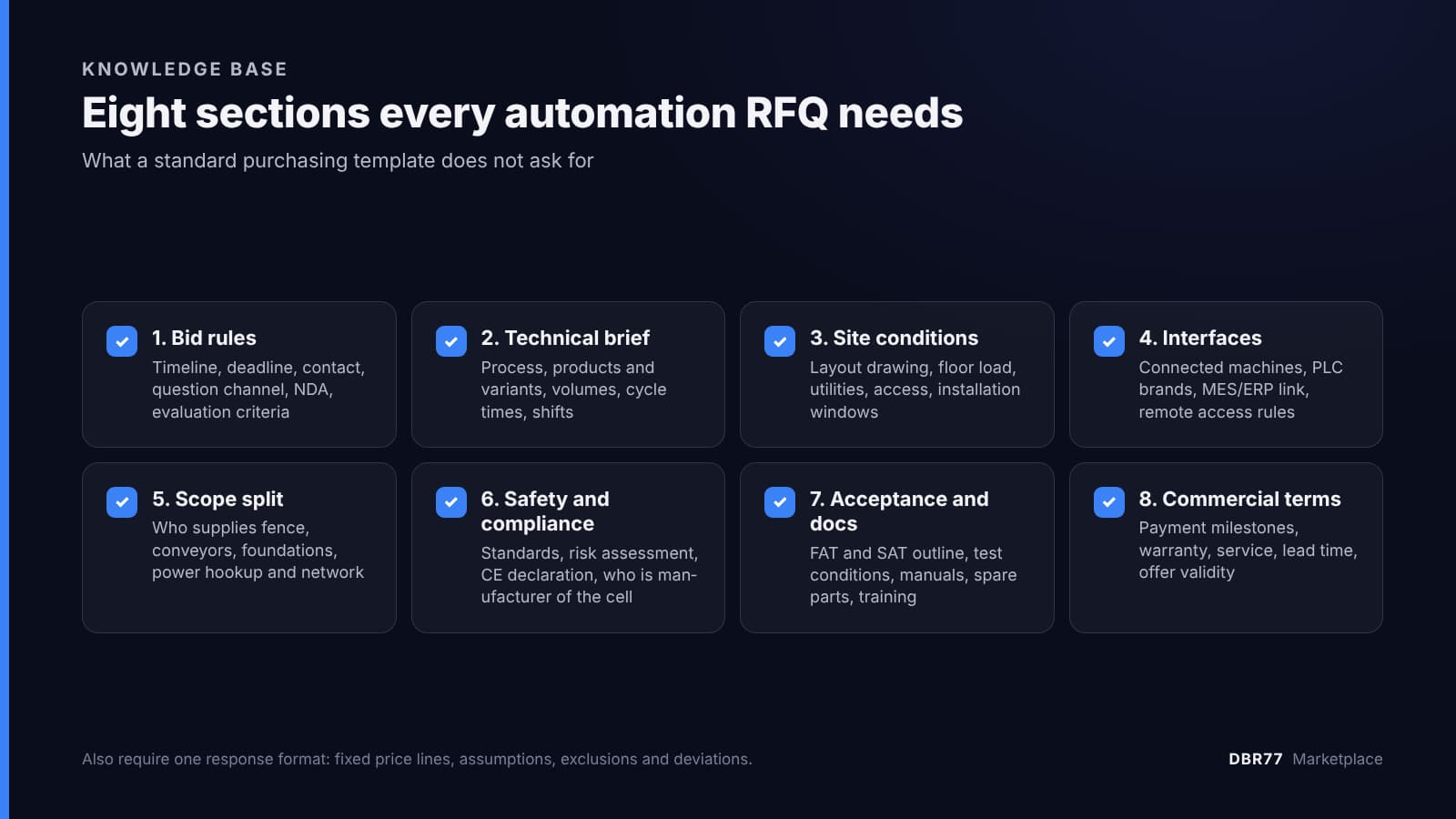
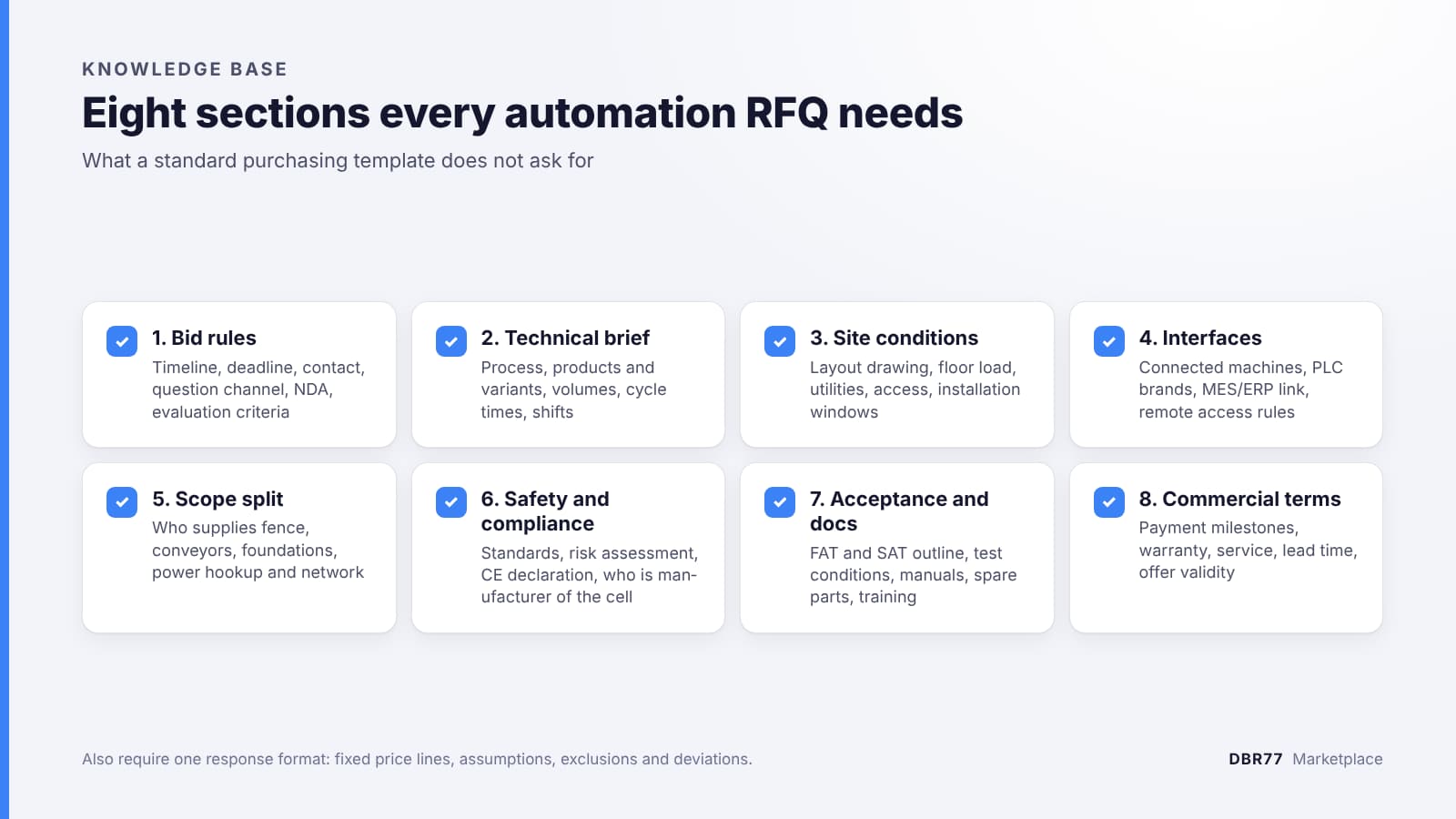
An automation RFQ needs eight sections that a standard purchasing template does not have: bid rules, the technical brief, site conditions, interfaces, a scope split between buyer and supplier, safety and compliance, acceptance and documentation, and the commercial terms you want quoted. It must also tell suppliers exactly how to answer. When every bidder prices the same package and replies in the same structure, you can compare offers line by line. If they price different packages, each price belongs to a different project.
Why a standard purchasing template does not fit automation
A standard purchasing template is built for catalog goods: part number, quantity, delivery date, price. An automation cell is a one-off machine built around your product, your floor and the equipment you already run. The price depends on things the template never asks: how many product variants, what cycle time the station must hold, who builds the safety fence, who programs the PLC interface.
When the RFQ is silent, each supplier fills the gap with its own assumption. One includes the infeed conveyor, another lists it as an option. The totals then look comparable although they cover different scopes.
Compliance widens the gap, because someone must carry responsibility for the conformity of the whole cell. In the EU, the European Commission states that the new Machinery Regulation (EU) 2023/1230 applies from 20 January 2027; machinery placed on the market before that date must comply with the Machinery Directive 2006/42/EC. In the US, A3 describes ANSI/A3 R15.06-2025 as the national adoption of ISO 10218 Parts 1 and 2. An automation RFQ therefore has to ask which standard the cell is designed to and who signs the declaration of conformity.
RFQ or RFP: decide what you are asking for
Send an RFQ when you know the type of solution and want prices for a defined scope, for example a robot palletizing cell for two known pallet patterns.
Send an RFP when you know the problem but not the solution. If suppliers could propose different technologies (a robot cell, an AGV route or a conveyor loop), you are asking for concepts.
Many automation purchases sit in between. A practical approach is two stages: ask for a concept and a budget price, hold a round of written clarifications, then ask the remaining bidders for a binding offer against the same updated package.
The eight sections of an automation RFQ
| Section | What to include | Why suppliers need it |
|---|---|---|
| 1. Bid rules | Timeline, deadline, contact person, question channel, NDA, evaluation criteria, currency | Everyone bids on the same terms |
| 2. Technical brief | Process, products and variants, volumes, current and target cycle time, shifts | Sizes the solution |
| 3. Site conditions | Layout drawing, floor load, power and compressed air, temperature, dust, access routes, installation windows | Drives design and installation cost |
| 4. Interfaces | Upstream and downstream machines, PLC brands, MES/ERP interface, remote access rules, data storage | Prevents integration surprises |
| 5. Scope split | Who supplies the fence, conveyors, foundations, electrical hookup, network, removal of old equipment | Stops gaps and double counting |
| 6. Safety and compliance | Standards to apply, risk assessment, CE marking and declaration, who acts as manufacturer of the cell | Names the compliance work and its owner |
| 7. Acceptance and documentation | FAT and SAT outline, test conditions, manuals, spare parts list, training | Defines when the job is done |
| 8. Commercial terms | Payment milestones, warranty, service response, spare parts, lead time, offer validity | Makes prices comparable |
Section 2 is the heart of the package; write it with How to Write an Automation Brief Integrators Can Quote. Three other sections are often missing from first drafts.
Scope split. List the items at the boundary of the cell and mark each one "supplier", "buyer" or "to be proposed": fence, foundations, cable trays, network connection, compressed air, dismantling the old station. This list prevents most "not included" lines in the offers.
Site conditions. A dimensioned layout drawing, the floor load, and the dates when installation can happen. If the plant only stops for two weeks in August, say so.
Acceptance. At RFQ stage one page is enough: what is tested at FAT, what at SAT, at what rate and for how long. The full criteria come later, using How to Set Acceptance Criteria, FAT and SAT for Automation.
For section 6, ISO 10218-2:2025 sets safety requirements for the integration of industrial robot applications and robot cells. Ask each bidder which standards its design follows and who performs and documents the risk assessment.
Send every integrator the same package
Publish your requirements as a Technology Challenge on DBR77 Marketplace and receive answers in one structure. Free for manufacturers.
The response format to require
To read the answers side by side, ask every bidder for:
- A price breakdown in fixed lines: robots and grippers, mechanics and conveyors, safety equipment, controls and software, engineering and programming, installation and commissioning, FAT and SAT, training, documentation, travel. Options priced separately.
- Lists of assumptions and exclusions.
- A list of deviations from your RFQ. This is the most useful page in any offer, because it shows where the supplier quoted something other than what you asked for.
- A layout drawing of the cell in your space, and cycle time evidence per product (calculation, test or simulation).
- A schedule from order to SAT, with what the buyer must deliver and when.
Send the format as a template. An offer that arrives in its own layout goes back with a request to refill it. To put the answers in one table, use How to Compare Automation Offers Side by Side; for payment terms, warranty and service, use How to Compare Automation Commercial Models, Not Just Prices.
Questions to ask every bidder
Every bidder answers the same questions in writing:
- Which cycle time does your concept reach for each product, and how did you get the number?
- What do you need from us, and by which date, to hold your lead time?
- Which parts of the work do you subcontract?
- Who acts as the manufacturer of the complete cell for conformity purposes?
- What happens to price and schedule if we add a product variant after the order?
- Who services the cell after the warranty, from where, and with what response time?
Share every question and answer with all bidders. One clarification given only by phone makes the comparison unfair.
A real example: what a complete first inquiry produced
HSV Polska makes EPP plastic products and needed an automated quality control and packaging line. According to the HSV case study published in March 2023, its first inquiry on the platform (then called Robot Platform) contained all the technical requirements the integrator needed.
Because the integrator did not have to guess, Redhawk answered with more than a price: a concept with a 3D simulation built in Studio 3D, an operational analysis and a financial analysis. The equipment was named: Fanuc M-10iD/8L robots (2032 mm reach, 8 kg payload), a Keyence CV-X470F vision system and Secomea remote access.
The 3D simulation confirmed a line cycle time of less than 120 seconds for all product codes in the project. That figure comes from simulation; the measured rate belongs in the acceptance tests.
For your own RFQ, list every product code and ask for cycle time evidence and the operational and financial analysis as part of the response. Testing a concept in simulation is covered in Before You Buy a Robot, Simulate It First.
How DBR77 Marketplace helps
On DBR77 Marketplace the RFQ is published as a Technology Challenge through a guided form in eight steps: maturity, type and classification, description, requirements, budget, files, operational assumptions and preview. The form covers most of sections 2 to 4, and the scope split, acceptance outline and commercial terms can be attached as files.
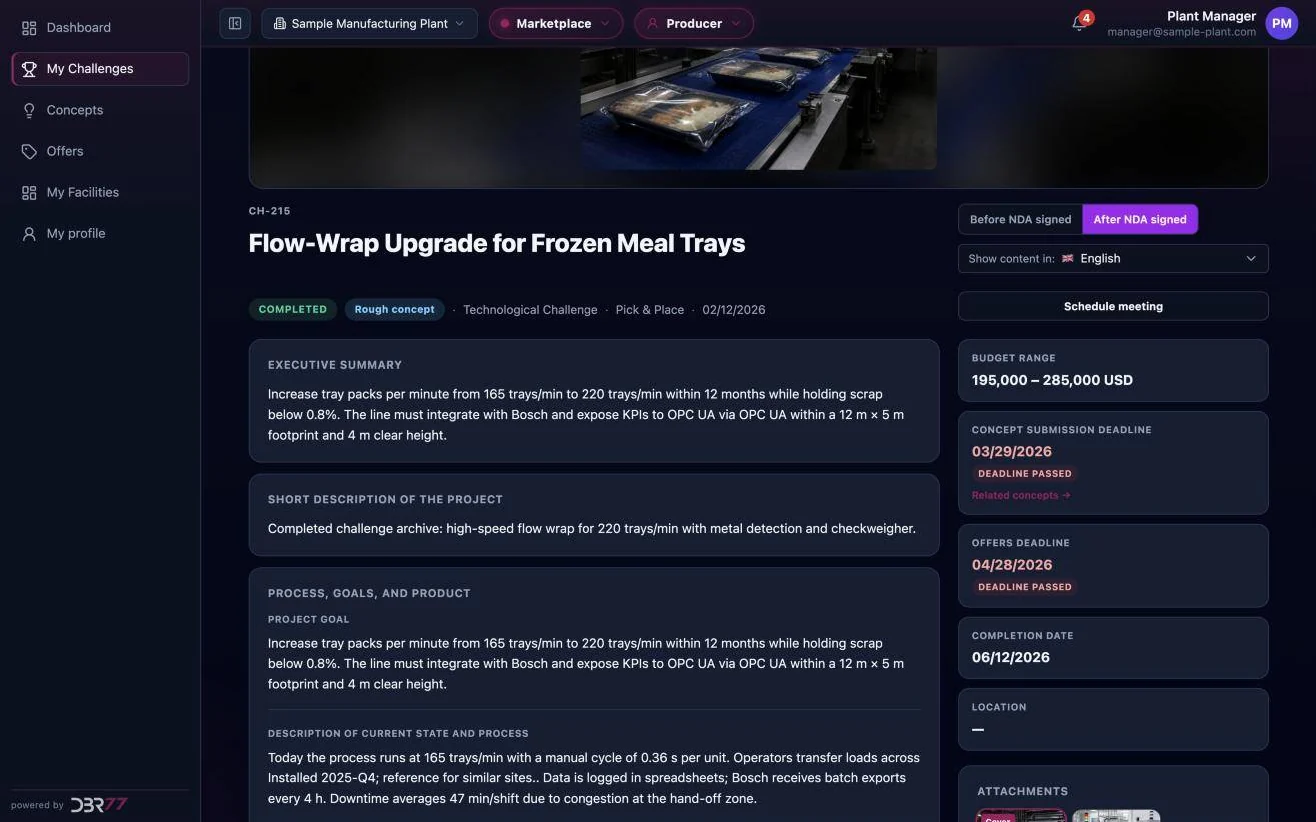
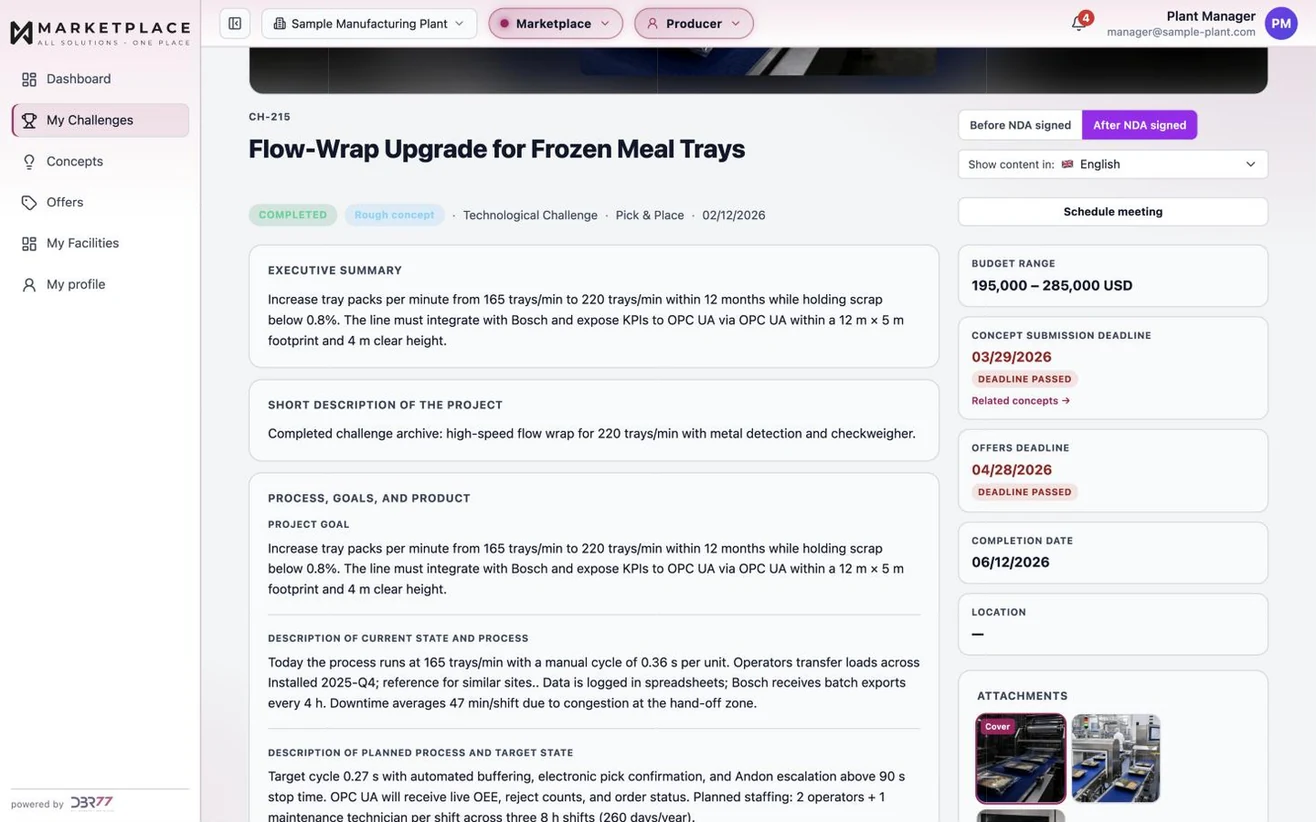
Questions go through a Q&A tab that every integrator sees, so each answer reaches all bidders. Integrators submit concepts first and offers second, in a standardized format with scope, conditions and costs, which follows the two-stage approach above.
FAQ
How long should an automation RFQ be?
It should cover the eight sections and stay short enough for a supplier to read in full.
Should we state a budget in the RFQ?
Yes. A budget range tells suppliers whether to propose a simple cell or a full line. Price competition stays as long as several suppliers bid against the same package.
How much time should suppliers get to respond?
Enough for a site visit and at least one round of written questions. Without them, suppliers price the risk of what they could not check.
Conclusion
Before the RFQ goes out, check it against the table: all eight sections filled in, the scope split marked item by item and the response template attached. Then send the same package and the six questions to every bidder, and share each answer with all of them.
Get offers that answer the same question
Post a Technology Challenge on DBR77 Marketplace, or ask our team how to prepare the package.
Post your Technology Challenge · Contact the Marketplace team
Sources
- European Commission, Machinery, undated, accessed October 2026
- A3, New ANSI/A3 R15.06-2025 American National Standard for Industrial Robot Safety Now Available for Purchase, 2025
- ISO, ISO 10218-2:2025 Robotics: Safety requirements, Part 2: Industrial robot applications and robot cells, 2025
- DBR77, HSV case study: a success story on the Robot Platform, 2023