How to Set Acceptance Criteria, FAT and SAT for Automation
By DBR77 Team · Published · Updated
Set acceptance criteria before the order, not when the equipment arrives. Write down what the cell or line must prove (safety, cycle time, quality, fault recovery, interfaces, documentation), under which conditions, with which test and which record. Then split the tests: the factory acceptance test (FAT) at the supplier's site proves the system works as built, and the site acceptance test (SAT) in your plant proves it works with your parts, your interfaces and your people. When this is agreed before delivery starts, acceptance becomes a check against a list. When it is not, it becomes a negotiation beside a machine.
Why acceptance disputes start before the order
Most acceptance disputes come from two different ideas of "done" rather than from bad equipment. The supplier's idea: the robot runs the program and the safety circuit works. The plant's idea: the cell runs all product codes at the required rate, on all shifts, without a technician standing next to it.
Both ideas are reasonable, but nobody wrote either one down before the contract. So the supplier plans delivery around its own finish line, the plant discovers missing items during start-up, and the final payment milestone turns into an argument.
Treat acceptance as part of the specification and write it into the brief you send to integrators, built as in How to Write an Automation Brief Integrators Can Quote. A requirement that cannot be tested needs rewording before the brief goes out, and every test needs an agreed record, or its result will be disputed.
What acceptance criteria should cover
Every criterion needs four parts: what is measured, the target or band, the test conditions, and the evidence. The table shows the usual set for a robot cell or a transport system.
| Area | How to write it measurably | Tested at | Evidence |
|---|---|---|---|
| Safety functions | Each safety function listed (fence doors, light curtains, scanners, emergency stops, safe speed) with expected reaction | FAT, repeated at SAT | Signed checklist per function, safety documentation |
| Cycle time and output | Units per hour or cycle time per product code, with the defined mix and feeding conditions | FAT (dry and with parts), SAT | Logged counts and times |
| Quality | Reject rate, placement or measurement accuracy against the plant's own gauges | FAT on sample parts, SAT on production parts | Sample results, quality records |
| Fault recovery | Named faults (jam, missing part, wrong label, power loss) and how the operator restores the cell | FAT and SAT | Test log, operator instructions |
| Interfaces | Each signal or message to PLCs, MES or ERP, with expected response | FAT with simulated signals, SAT with real systems | Signal list checked off |
| Performance run | Output and stops over an agreed period of normal production | SAT only | Production report |
| Documentation and training | Manuals, electrical drawings, backups, spare parts list, trained operators and maintenance staff | Before final acceptance | Delivered files, training records |
Also write the product mix, because "120 units per hour" means little if the supplier tests the easiest code, and the conditions: pallet quality, part temperature, upstream speed.
For safety, ask which standards the cell is designed to. For robot cells, ISO 10218-2:2025 sets safety requirements for integrating industrial robot applications and robot cells, including commissioning. Agree which safety records you will receive and when.
Write acceptance into the challenge
On DBR77 Marketplace you describe target cycle times and operating conditions up front, so every integrator quotes against the same finish line.
What the FAT should prove
The FAT happens at the supplier's workshop before shipping, to find problems while they are cheap to fix. The process industry has a standard for it: IEC 62381, whose 2024 edition gives checklists for FAT, SAT and site integration tests so that owners and vendors agree on test scope and responsibilities.
A useful FAT has:
- a written test plan sent in advance, with each test linked to a requirement in the specification;
- real or representative parts from the plant, in enough quantity and variety to cover the product codes in scope;
- a frozen software version: note the PLC and robot program versions tested, so the same versions are installed on site;
- simulated interfaces marked as simulated: if MES signals are simulated at FAT, the record says so, and the SAT tests them for real;
- a punch list with owners and dates, so every open point is written down before the cell is dismantled and shipped.
Send the people who will live with the cell: a maintenance technician, a process engineer and a lead operator. They spot practical issues (cleaning access, how a jam is cleared) that a buyer would miss.
What the SAT and the performance run should prove
The SAT repeats the critical FAT tests in your plant and adds what could not be tested before: real interfaces, real guarding in the real layout, real material flow from upstream and downstream.
Plan the SAT in two steps:
- Functional SAT. Safety functions, interfaces and fault recovery are tested and signed. The cell can then run production under supervision.
- Performance run. The cell runs normal production for an agreed period, with the plant's operators. Output, rejects and stops are logged and compared with the criteria.
Agree on the length of the run and the rules in advance: which stops count against the supplier (equipment faults), which do not (missing parts from upstream, planned breaks), and what happens if the run is interrupted. Without rules, the same log can be read two ways.
Allow a stabilization window between the functional SAT and the performance run, with an end date and exit criteria. Some tuning on site is normal; the end date keeps it from becoming an open-ended "we will optimize later".
Who signs, and how to handle open points
Name the approvers before the order: usually engineering, quality, maintenance, safety and the area's production manager. An approver who first sees the list at SAT will add new requirements at SAT.
Sort open points into classes:
- Class A: safety or output is affected. No acceptance until fixed.
- Class B: the cell can run, but the item must be fixed by an agreed date.
- Class C: minor or cosmetic. Fixed during the warranty period.
Conditional acceptance with a dated Class B list keeps the project moving. Link acceptance steps to payment milestones in the contract, using the clause checklist in What to Check Before Signing an Automation Contract.
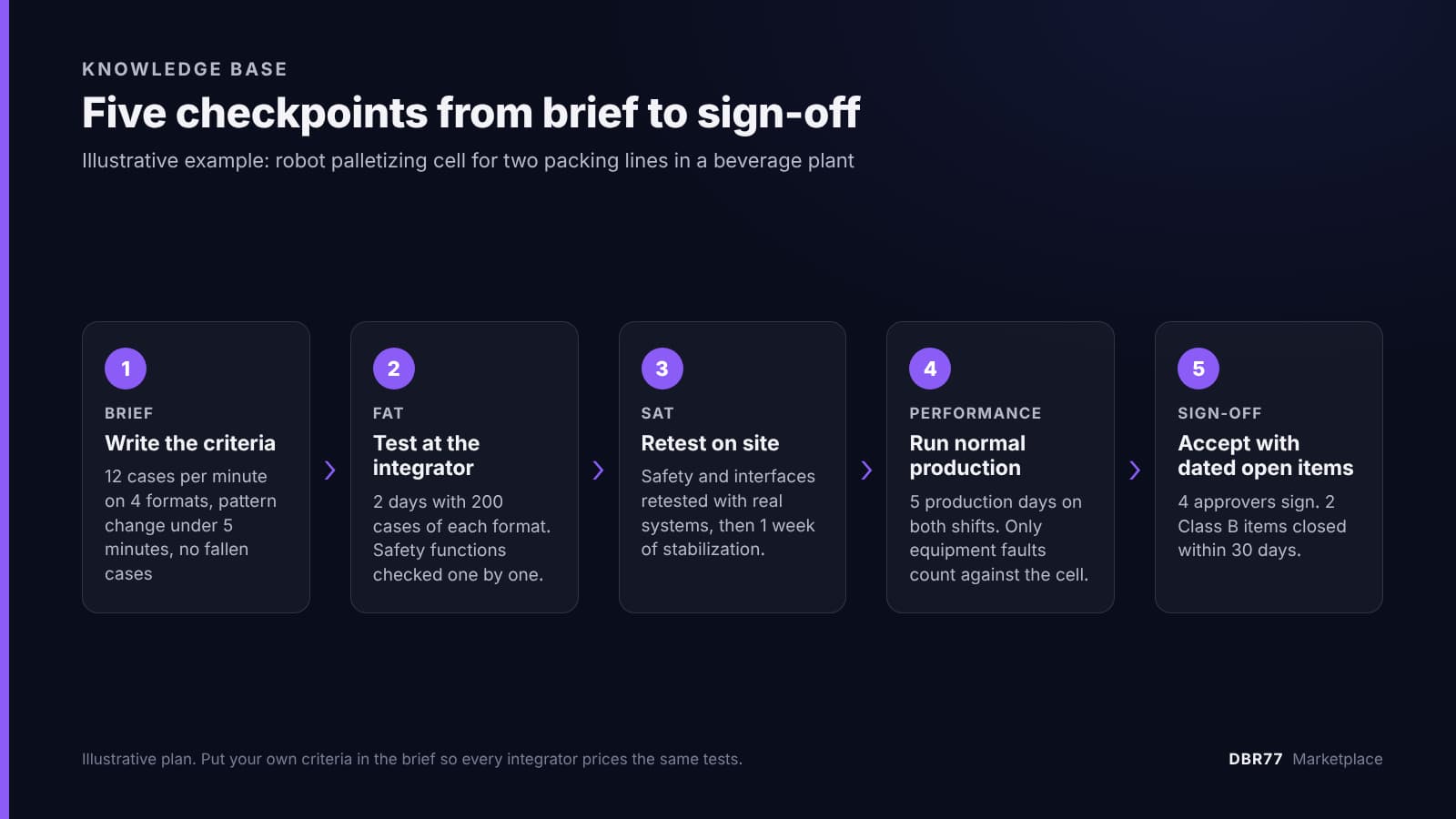
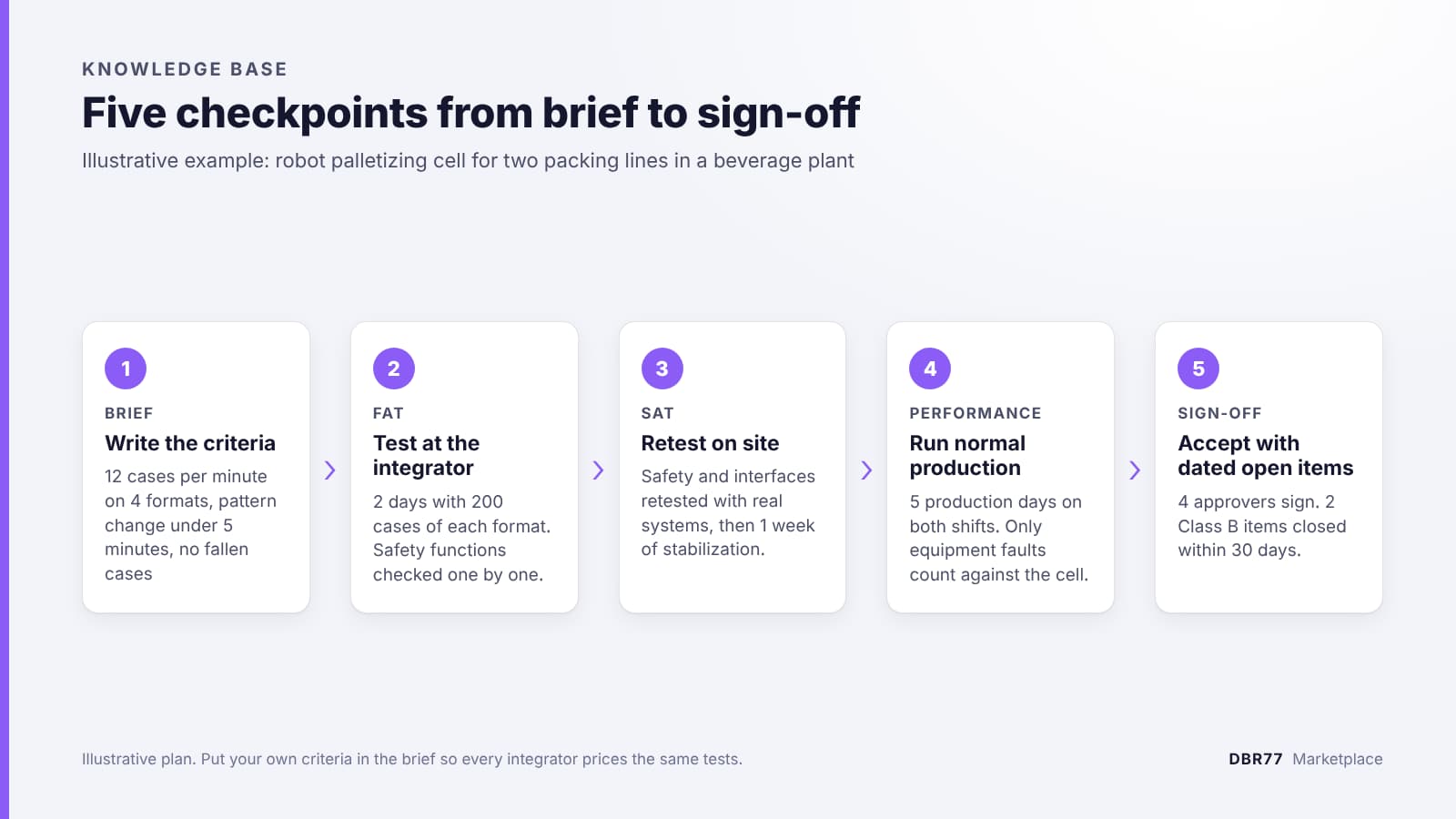
Illustrative example: acceptance plan for a palletizing cell
A mid-size beverage plant orders a robot palletizing cell for two packing lines.
- Criteria in the brief: 12 cases per minute on the four main case formats, pallet patterns per customer standard, no fallen cases over a full shift, change of pattern by the operator in under 5 minutes.
- FAT: two days at the integrator's workshop with 200 cases of each format sent from the plant. Safety functions checked one by one. Interface to the line PLC simulated and marked as such.
- SAT: safety and interfaces retested on site, then one week of stabilization.
- Performance run: five production days on both shifts. Stops logged by cause. Only equipment faults count against the cell.
- Sign-off: engineering, maintenance, safety and the packing manager. Two Class B items (a guard handle and a label on the HMI) closed within 30 days.
All of these were in the brief, so every integrator priced the same tests. If a pilot ran first, start from its pass band, defined as in How to Run an Automation Pilot or Paid Discovery Phase First.
How DBR77 Marketplace helps
The guided Technology Challenge form on DBR77 Marketplace has a requirements step and an operational assumptions step, which is where your acceptance criteria, target cycle times and operating conditions go before any supplier quotes. Offers then come back in a standardized format with scope, conditions and costs, so you can see which ones include FAT, SAT, training and documentation and which list them as exclusions. For the handover to delivery, continue with From Supplier Selection to Delivery: A Clean Handoff.
FAQ
Do we need a FAT for a small cell?
Usually yes, even a short one. A one-day FAT with your parts finds problems that would cost a week on site. Skip it only for standard equipment delivered many times in the same configuration.
Who pays if the cell fails acceptance?
That depends on the contract. As a rule, the supplier fixes failures against agreed criteria at its own cost, and the plant pays for changes to the criteria. This is why criteria must be fixed before the order.
Can we change the criteria after the contract is signed?
Yes, through a change order with its effect on price and time. Changing criteria informally during start-up is the most common source of acceptance disputes.
Conclusion
Before the brief goes out, take the table above, fill in a target, test conditions and evidence for each area that applies to your cell, and name the people who will sign at SAT. For the risks that follow between contract and go-live, use How to Reduce Risk Between Contract and Go-Live.
Agree on "done" before anyone builds
Post a Technology Challenge with your target cycle times and site conditions, or ask our team how to write acceptance criteria into it.
Post your Technology Challenge · Contact the Marketplace team