The Real Cost of Automation: TCO Beyond the Quote
By DBR77 Team · Published · Updated

The real cost of automation is the supplier's quote plus everything the quote does not cover: work the plant does itself, internal hours, production lost during installation, the ramp-up months, and the running costs of the cell over its whole life. Total cost of ownership (TCO) puts all of these on one sheet, over a fixed number of years, so you compare full costs instead of headline prices. Two offers with the same price can have very different TCO, and the lower quote often ends up as the more expensive cell. The right comparison is the TCO of the automated station against the full cost of staying manual over the same period.
Why the quote is only part of the cost
A quote covers the supplier's scope and nothing else. Foundations, power and compressed air to the cell, the network connection, moving an old machine, your engineers' hours, travel to the FAT and the weeks when the line runs slower than planned all land on the plant's budget, often in different cost centers.
Capital cost gets most of the attention. In McKinsey's 2022 survey of industrial companies, 71 percent named the capital cost of robots as a barrier to automation. That focus hides the costs that come after the purchase order and can make a cell with a low quote and high running costs look like the safer choice.
Methods for life cycle costing have existed for years. IEC publishes IEC 60300-3-3:2017, an application guide on life cycle costing intended for managers, engineers, finance staff and contractors. In German machine building, VDMA 34160 is a forecasting model for lifecycle costs of machines and plants. You can start without either standard if you keep their discipline: every cost, every year, one horizon.
The four groups of automation TCO
| Group | Cost lines | Who has the number |
|---|---|---|
| 1. Acquisition | Supplier quote and options, plant-side work (foundations, utilities, network, guarding if excluded, removal of old equipment), internal engineering and project hours, FAT travel, external safety or compliance support | Supplier, engineering, maintenance, project owner |
| 2. Start-up and ramp-up | Output lost during installation, temporary manual staffing while the cell stabilizes, scrap during tuning, operator and maintenance training | Operations, planning, quality |
| 3. Operation | Operator and technician time, preventive maintenance, spare parts, wear parts (grippers, suction cups, belts), energy and compressed air, consumables, software licenses and updates, service contract after warranty | Supplier, maintenance, finance |
| 4. Change and end of life | Reprogramming for new products or pallet patterns, upgrades, replacing obsolete controllers or PCs, dismantling, minus resale value | Engineering, supplier, finance |
Group 1 is usually known before the order. Groups 2 to 4 are where most surprises come from, and they are spread over years, so a comparison of quotes misses them.
Plant-side costs that no supplier quotes
Every automation project has work at the boundary of the supplier's scope. Typical items:
- Civil and utility work: floor preparation, anchoring, power supply, compressed air lines, lighting.
- Network and IT: cabling, switches, firewall rules, the MES/ERP interface on your side, remote access setup.
- Removal and relocation: dismantling the old station, moving racks or conveyors to free space.
- Internal hours of engineering, maintenance, IT, safety and the project owner, from brief to SAT. On a first project these hours are often larger than expected, because the team is learning.
- Production impact: downtime during installation and tie-in, overtime or weekend shifts to build stock beforehand.
For each line, write down who does the work if the supplier does not, and which budget pays for it. That cost goes into the TCO sheet even when it never becomes an invoice.
Make the supplier's scope visible before you calculate
Publish your project as a Technology Challenge on DBR77 Marketplace and receive offers with scope, assumptions and exclusions in one format. Free for manufacturers.
Ramp-up: the months between SAT and full output
A cell that passes its site acceptance test still needs time before it runs at full output on every shift. Operators learn new routines, maintenance learns the failure modes, and small issues appear only with real product mix and real shift changes. During that period many plants keep part of the manual crew on standby.
Budget ramp-up as its own line: how many weeks of reduced output you expect, how many people stay on the old job during that time, and how much extra scrap tuning will cause. Ask each supplier what ramp-up support is included after SAT, for how long, and on site or remote. A supplier who includes two weeks of on-site support after SAT and one who leaves after the test can quote the same price and produce very different ramp-up costs.
Running costs over the life of the cell
Running costs look small per month and add up over the life of the cell. Ask every supplier for the same data, in writing:
- A maintenance plan with tasks, intervals and the hours each takes.
- A recommended spare parts list with prices, and which parts wear fastest.
- Energy and compressed air consumption at rated output.
- Software: which licenses are needed, whether they renew yearly, and who pays for updates.
- Service after warranty: price of a service contract, response time, and how long spare parts stay available.
Then choose a horizon. Use the period you expect to run the cell, often the shorter of the depreciation period and the expected life of the product it handles, and use the same horizon for the manual alternative. Payment terms, warranty, leasing and robot-as-a-service change the cash picture too; How to Compare Automation Commercial Models, Not Just Prices goes through each model.
An illustrative TCO calculation
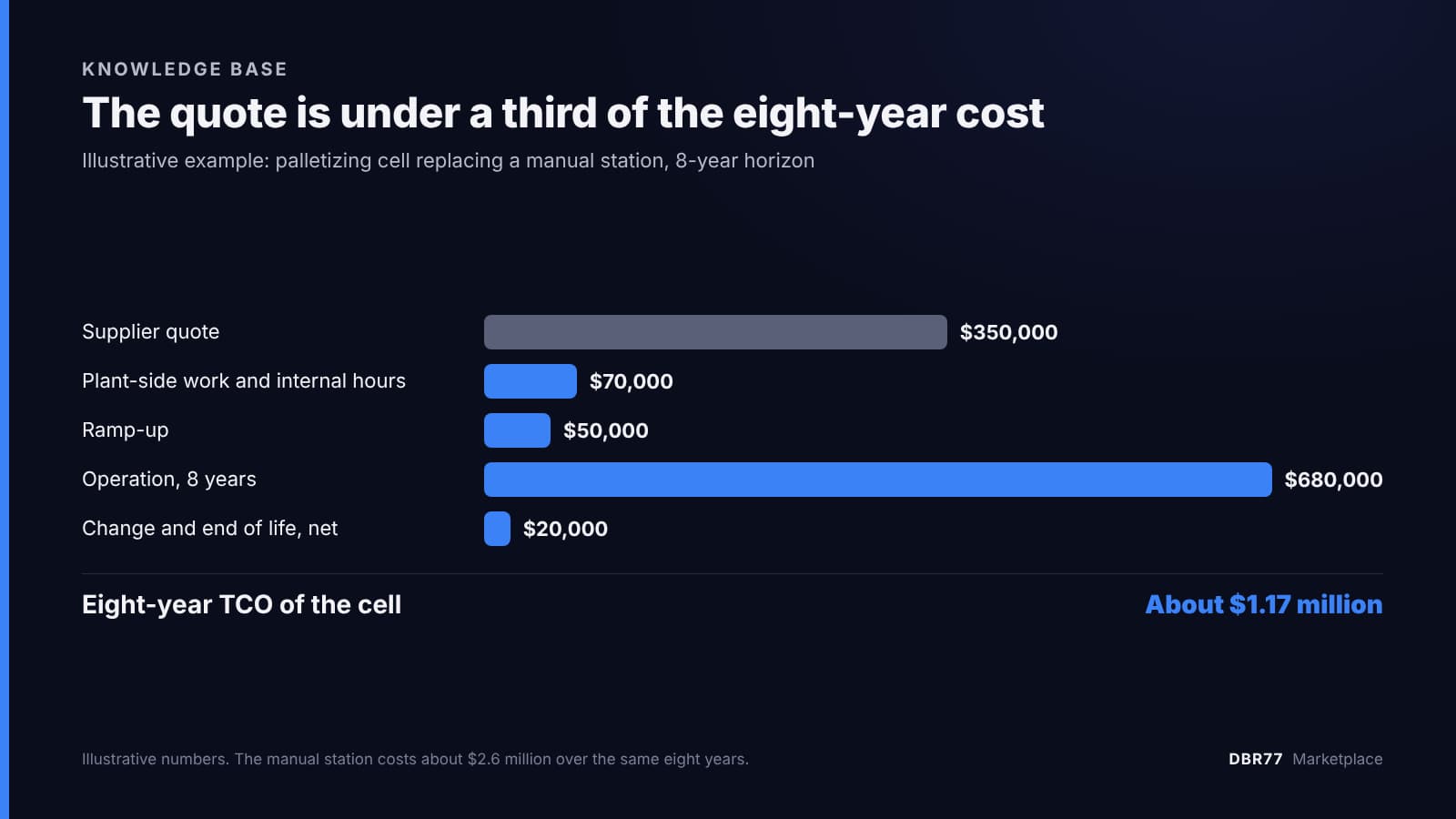
Illustrative example: a palletizing cell replacing the manual station from The Hidden Cost of Manual Processes in Manufacturing, which costs about $327,500 a year in full. All figures are round numbers to show the method, over an eight-year horizon.
- Acquisition: quote $350,000, plant-side work $40,000, internal hours and FAT travel $30,000. Total $420,000.
- Ramp-up: three months with part of the manual crew on standby, plus tuning scrap. Total $50,000.
- Operation: one operator shared across both shifts $55,000, maintenance and spare parts $15,000, energy and consumables $8,000, service contract and software $7,000. Total $85,000 a year, or $680,000 over eight years.
- Change and end of life: reprogramming for new pallet patterns $40,000 over eight years, minus $20,000 resale value. Net $20,000.
Eight-year TCO: about $1.17 million. The quote is under a third of it. The manual station over the same eight years costs about $2.6 million.
Run three versions: expected, cautious (longer ramp-up, higher maintenance) and stressed (lower output, one major repair). If the decision only holds in the expected case, rework the scope; a cheaper supplier will not close that gap. To take the result to the board, use How to Build an Automation Business Case the Board Will Approve.
How DBR77 Marketplace helps
On DBR77 Marketplace, integrators submit offers in a standardized format that lists scope, conditions and costs, including installation, training, support, warranty and payment terms. You can see which plant-side items each offer leaves to you, and the training and support lines go straight into the ramp-up and operation groups of your TCO sheet. Questions about running costs, spare parts or software licenses go through the Q&A tab, where every integrator sees both the question and the answer. To put the offers into one table, follow How to Compare Automation Offers Side by Side.
FAQ
What time horizon should an automation TCO use?
The period you expect to run the cell, and the same period for the manual alternative. Many plants use the shorter of the depreciation period and the expected life of the product the cell handles.
Should internal staff hours be part of TCO?
Yes. They are not invoices, but engineers, maintenance and IT spend real time on the project instead of other work. Estimate the hours per function and price them at an internal rate finance agrees with.
Is the lowest quote usually the lowest TCO?
Not reliably. A lower quote can mean less included scope, less ramp-up support or higher running costs. Compare TCO over the same horizon and the same scope before you draw conclusions.
Conclusion
Before you compare prices, list the plant-side work each quote leaves to you and ask every supplier for the same running-cost data. Then put each offer and the manual station into the four groups over one horizon, and calculate the expected, cautious and stressed versions. If automation only wins in the expected case, rework the scope before you choose a supplier.
Compare offers on what they really cost
Post a Technology Challenge on DBR77 Marketplace, or ask our team how to request the cost data you need.
Post your Technology Challenge · Contact the Marketplace team
Sources
- McKinsey & Company, Unlocking the industrial potential of robotics and automation, 2023 (survey conducted in August 2022)
- IEC, IEC 60300-3-3:2017 Dependability management, Part 3-3: Application guide, Life cycle costing, 2017
- DIN Media, VDMA 34160: Forecasting model for lifecycle costs of machines and plants, 2006