How to Build an Automation Business Case the Board Will Approve
By DBR77 Team · Published · Updated
A board approves an automation project when the business case answers five questions in a few pages: why the project is needed now, which options were compared and why this one won, how it will be bought, whether the company can afford it over its whole life, and who will deliver it and how success will be measured. Most rejections and postponements come from gaps in the pack: one ROI figure with no visible assumptions, no alternatives, risks left out, and plant-side work marked "to be defined." Build the case around the five questions, show the drivers behind the return, put risks and owners on the same page, and keep the detail in an appendix.
Why boards reject or postpone automation projects
Boards see more automation requests than they used to. In McKinsey's 2022 survey of industrial companies, the authors note that for many, automated systems will account for 25 percent of capital spending over the next five years. Bigger and more frequent requests get harder questions.
The usual reasons for a "no" or a "come back next quarter":
- A single ROI figure with no drivers, so the board cannot see what has to be true for the return to happen.
- Only one supplier's concept, which leaves the board unable to tell whether the solution is the right size.
- Risks missing or hidden in a footnote, where the first tough question finds them and makes the whole case look weak.
- No owner and no plant-side plan: nobody has said who runs the project or what the plant itself has to deliver.
- A vague definition of success that nobody can measure, such as "successful start-up."
All five sit in the pack rather than in the project, so you can fix them before the meeting.
The five questions every automation business case must answer
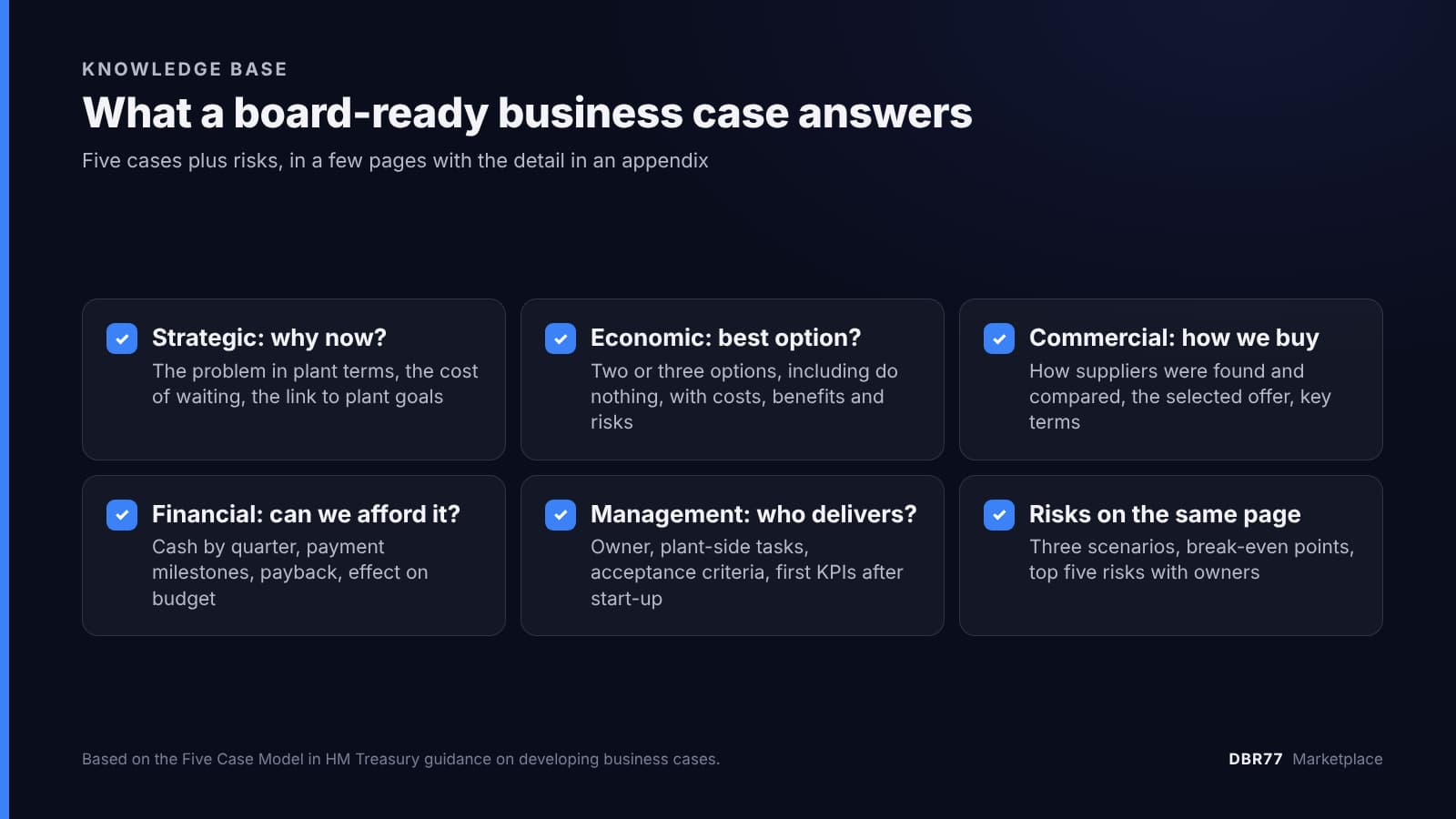
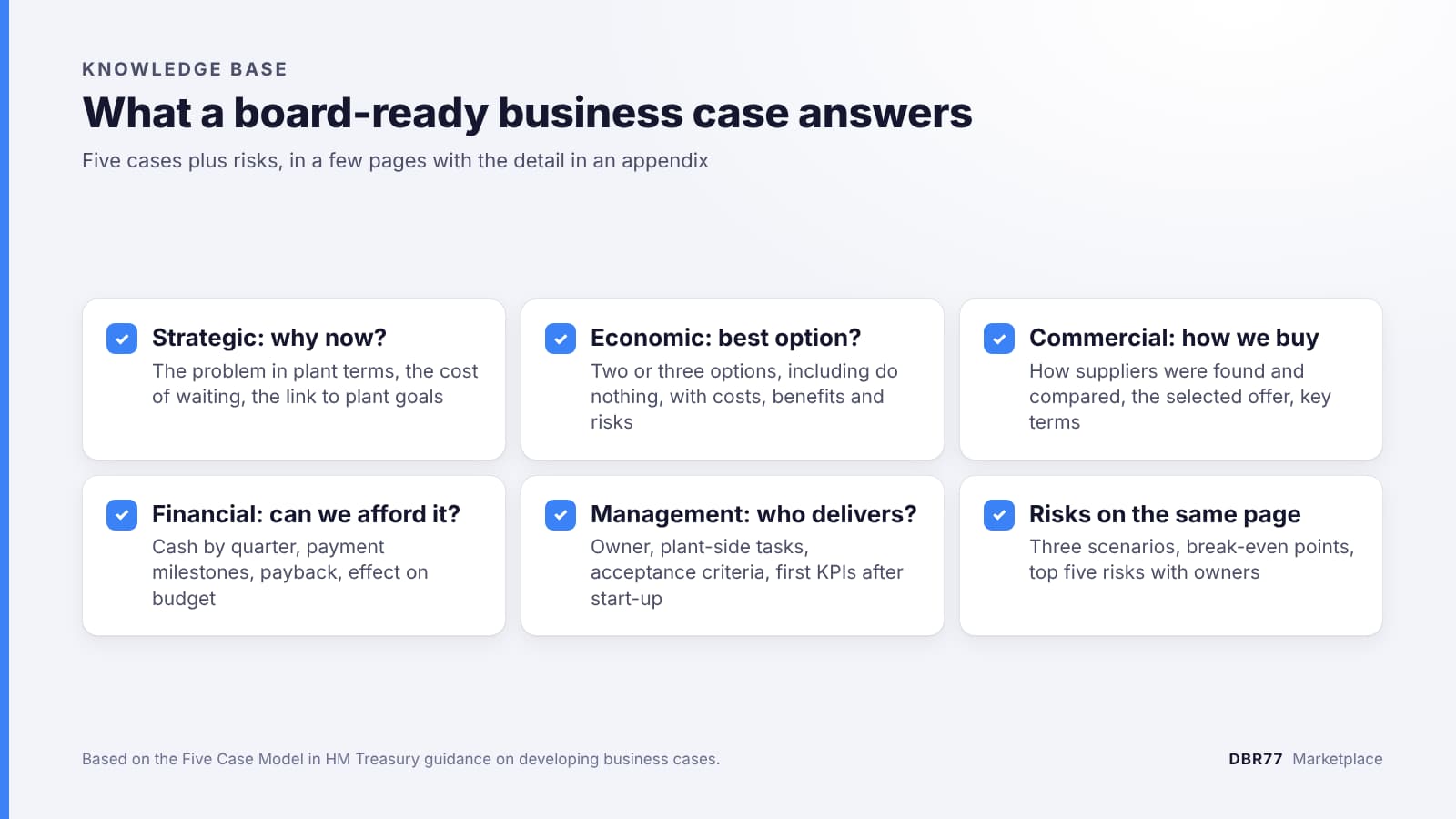
A useful structure comes from public investment. HM Treasury's Guidance on Developing Business Cases uses a Five Case Model: the strategic case sets out why a proposal is needed, the economic case assesses the costs, benefits and risks of different options, the commercial case describes how the inputs will be sourced, the financial case is concerned with affordability, and the management case sets out the practical arrangements for implementation. It translates well to a plant.
| Case | The board's question | What to show | Evidence |
|---|---|---|---|
| Strategic | Why this, why now? | The problem in plant terms, the cost of waiting, link to plant goals | Baseline data, monthly cost of the manual process |
| Economic | Is this the best option? | Two or three options, including "do nothing" and a smaller step, with costs, benefits and risks | Offers, TCO per option, simulation or test results |
| Commercial | How will we buy it? | How suppliers were found and compared, the selected offer, main contract terms | Comparison table, offer, draft contract |
| Financial | Can we afford it? | Cash by quarter, payment milestones, payback, effect on budget | Finance model, milestone plan |
| Management | Who delivers it, and how do we know it worked? | Owner, plant-side tasks, acceptance criteria, first KPIs after start-up | Project plan, acceptance outline, KPI list |
The economic case is where many packs are thin. "Do nothing" is always an option, and its cost is the full cost of the manual process; The Hidden Cost of Manual Processes in Manufacturing shows how to calculate it. The commercial case rests on a fair comparison of offers, which you can build with How to Compare Automation Offers Side by Side.
Show what drives the return
A payback period or NPV summarizes the case, and the board will ask what drives it. List each benefit and cost line separately: labor hours, overtime, scrap, injuries, extra capacity, maintenance, energy, software, service. For each line, give the source and the type of evidence:
- Measured: data from your own line, such as output per shift or scrap rate.
- Historical: last year's overtime, agency invoices, injury costs.
- Supplier commitment: a cycle time or availability the supplier will test at acceptance.
- Estimate: a judgment, labelled as one, with the name of the person who made it.
Use the full life cycle cost instead of the quote, with the cost lines from The Real Cost of Automation: TCO Beyond the Quote. Show cash timing by quarter, because a deposit at order, a payment at FAT and a retention after SAT affect the budget differently from one lump sum.
Bring real offers to the board
Publish your project as a Technology Challenge on DBR77 Marketplace and compare offers in one format before you ask for approval. Free for manufacturers.
Put risks and sensitivity on the same page
Boards trust a case that shows where it could fail:
- Three scenarios: expected, cautious and stressed. Change the drivers that matter most: output reached, ramp-up length, maintenance cost, product volume.
- Break-even points: at what output, or what volume, does the project stop paying back within the target period? If the answer is "only at full rated speed from day one," the board should know.
- Top risks with owners: five risks at most, each with a mitigation and a name. Typical ones: integration with an existing PLC or MES, product changes during delivery, lead time of the main components, operator acceptance, ramp-up taking longer than planned.
Illustrative example: a case for an automated transport route shows a payback of three years in the expected scenario and five in the stressed one, where volume drops by a fifth. The board approves on one condition that costs nothing: a review after six months of operation, with real output data.
What goes into the decision pack
A board member should understand the decision without opening the appendix.
Core pack, in this order:
- One-page summary: the decision requested, amount, timeline, expected result, top three risks.
- The problem and the baseline, with the cost of waiting per month.
- Options compared and why the selected one won.
- The selected offer: scope, exclusions, supplier, main terms.
- Financials: TCO, cash by quarter, payback, scenarios.
- Delivery: owner, plant-side tasks, milestones, acceptance criteria, KPIs for the first months.
- The decision requested, with any conditions or gates.
Appendix: the full comparison table, the assumption list, the offers, the layout drawing, simulation or test results, and meeting notes. Number the versions of the pack, so that when the board returns to the topic a month later, everyone knows which version was approved.
If uncertainty is still high, ask for a staged decision: approve a paid concept phase or pilot now, and the full investment after it delivers agreed results. How to Run an Automation Pilot or Paid Discovery Phase First explains how to set up that first stage.
A readiness test before you book the board slot
Before you ask for time on the agenda, check that the sponsor can answer these without opening a slide:
- What problem are we solving, and what does it cost us per month today?
- What else did we consider, including doing nothing?
- How were suppliers compared, and why this one?
- What does the plant itself have to deliver, and who owns it?
- What will acceptance prove, in numbers?
- What is the worst realistic case, and what do we do then?
- What will we check first after start-up, and when do we report back?
If any answer needs a separate meeting, the pack is not ready. Delaying your own request by two weeks costs less than a board postponing it by a quarter.
How DBR77 Marketplace helps
On DBR77 Marketplace, integrators submit solutions (concepts) first and then offers in a standardized format with scope, conditions and costs, so the economic and commercial cases rest on several real options the board can check. The manufacturer accepts or rejects each solution and offer, which leaves a record of how the choice was made. Where the case depends on a new layout or material flow, a simulation in DBR77 DT can supply evidence for the economic case; How to Build a Digital Twin Business Case shows how to prepare that part.
FAQ
How long should an automation decision pack be?
A one-page summary and a core pack of a few pages, plus an appendix. If the core needs more, the decision is not yet clear enough.
What payback period will the board accept?
There is no general rule. It depends on your company's hurdle rate and strategy. Ask finance for the target payback or required return before you build the case, and show how the project performs against it in all three scenarios.
Should we have supplier offers before going to the board?
For the final investment decision, yes. Real offers make the economic and commercial cases credible. If you need budget before you can ask for offers, request a budget range first and present the final decision with offers in hand.
Conclusion
Before you book the board slot, run the readiness test with your sponsor and close every gap it shows. Then send a core pack built on the five questions, with real offers, three scenarios and named risk owners, and ask for a decision with clear conditions, or for a staged decision if uncertainty is still high.
Build your business case on comparable offers
Post a Technology Challenge on DBR77 Marketplace, or ask our team how to prepare the comparison for your board.
Post your Technology Challenge · Contact the Marketplace team
Sources
- McKinsey & Company, Unlocking the industrial potential of robotics and automation, 2023 (survey conducted in August 2022)
- HM Treasury, Guidance on Developing Business Cases for Projects and Programmes, 2026