What to Check Before Signing an Automation Contract
By DBR77 Team · Published · Updated
Before you sign, check that the contract describes the same project you compared. The scope and exclusions must match the final offer. Your plant's own obligations must be listed with dates. Changes need a written procedure and agreed rates. Acceptance must point to FAT and SAT criteria, and payments, delay remedies, warranty, liability, software rights and CE responsibility must be clear. Read every clause with one question: what happens on the day this goes wrong? If the text no longer matches the offer you evaluated, fix it before signing or reopen the decision.
Make sure the contract describes the project you compared
A careful comparison is often lost at the contract stage. The supplier's standard terms arrive with the order confirmation, the scope shrinks to one paragraph, and the Q&A answers are not attached.
Start with the list of contract documents and their order of precedence. A typical set for a robot cell: the contract agreement, the commercial conditions, the technical specification or final brief (with its version number), the final offer, the Q&A log with all answers, the layout drawing, the acceptance protocol and the payment schedule. If the supplier's general terms conflict with yours, the contract should say which one wins.
Many European suppliers already work with Orgalim SI 24, general conditions for the supply and installation of mechanical, electrical and electronic products, published in 2024. Larger plant projects sometimes use the FIDIC Yellow Book (Conditions of Contract for Plant and Design-Build, 2017), made for electrical and mechanical plant designed by the contractor. These conditions save drafting time on the general terms. The project-specific parts you still write yourself.
The clauses to check, one by one
| Clause | What to check | Warning sign |
|---|---|---|
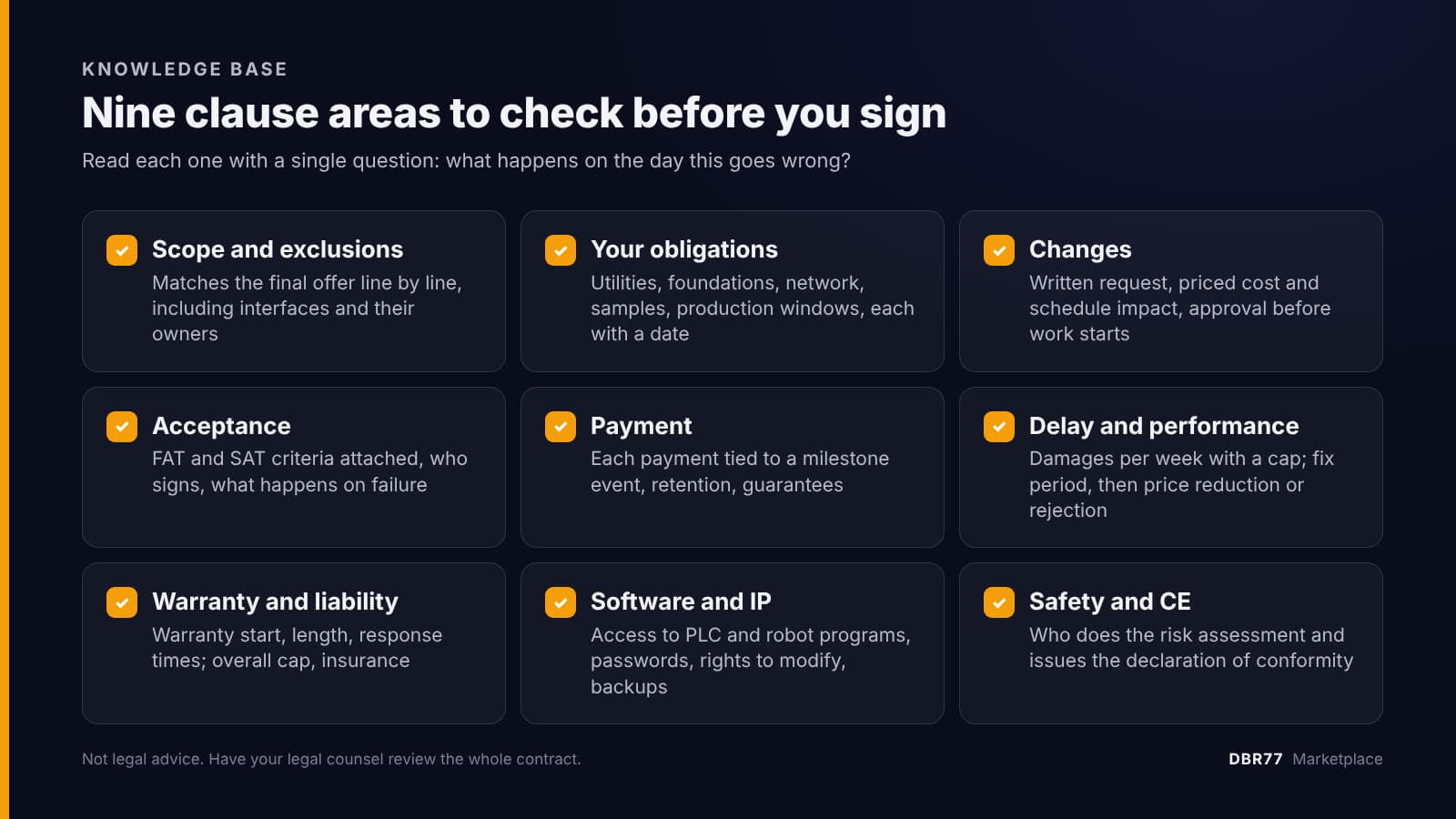
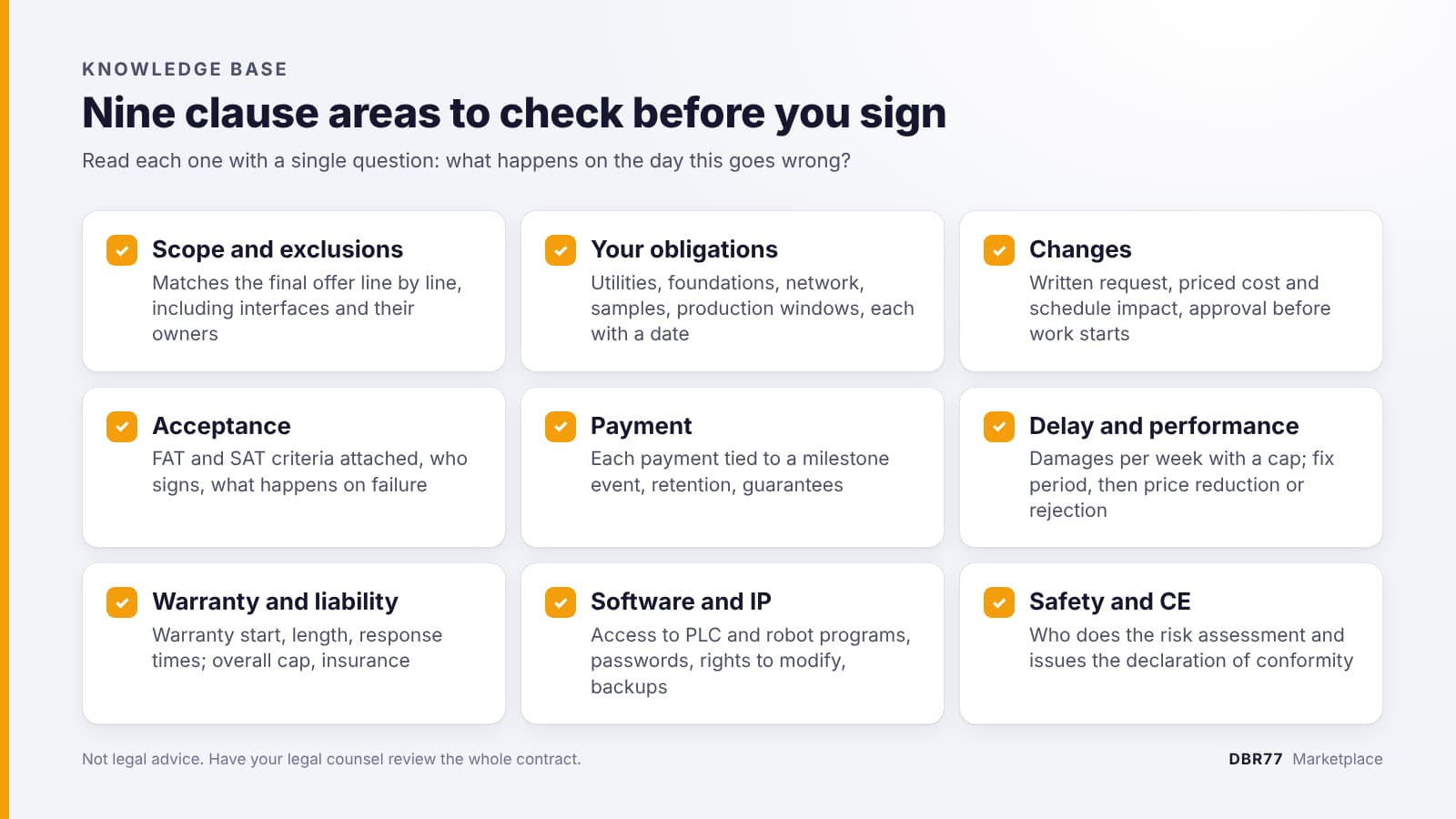
| Scope and exclusions | Matches the final offer line by line, including interfaces and their owners | "Turnkey" with no list of exclusions |
| Your obligations | Utilities, foundations, network, samples, production windows, each with a date | Buyer duties described as "timely cooperation" |
| Changes | Written request, priced impact on cost and schedule, approval before work starts | Changes priced "at prevailing rates" |
| Acceptance | FAT and SAT procedures and criteria attached, who signs, what happens on failure | "Acceptance on successful start-up" |
| Payment | Each payment tied to a milestone event, retention, guarantees | Payments by date regardless of progress |
| Delay | Agreed damages per week of delay, a cap, and what counts as excused delay | No consequence, or one so high no supplier will accept it |
| Performance | Remedy if the cell misses the agreed rate: fix period, then price reduction or rejection | No remedy short of termination |
| Warranty and service | Start, length, coverage, response times | Warranty from shipment |
| Liability | Overall cap, exclusions such as lost production, insurance | Cap far below the contract value |
| Software and IP | Access to PLC and robot programs, passwords, rights to modify, backups | Locked programs only the supplier can change |
| Safety and CE | Who does the risk assessment and issues the declaration of conformity | Not mentioned |
| Title and risk | When ownership and risk of loss pass to you | Silent, or ownership at full payment only |
Payment structure, warranty length, leasing and other commercial terms are compared before award, with the method from How to Compare Automation Commercial Models, Not Just Prices. The contract then has to carry exactly what you agreed.
Start the contract from a clear, comparable offer
On DBR77 Marketplace, offers state scope, conditions and costs in one standardized format, and all clarifications sit in one Q&A. Free for manufacturers.
Change orders: the clause you will use most
Every automation project changes during delivery: a product variant is added, a sensor moves, the conveyor height differs from the drawing. A clear change clause turns each of these into a routine step.
Check that the change clause covers:
- who can request a change and who on each side can approve it, with spending limits;
- pricing: day rates for engineering, programming and site work, and a markup on parts, fixed in the contract;
- the schedule: every change request states its effect on the end date;
- a rule that no work starts before written approval, except for safety issues;
- what is not a change: work needed to meet the agreed specification is the supplier's job, even if it was missed in the offer.
Most change order disputes start where the scope was vague or an assumption was never checked. If the floor load, the network path or the condition of an existing machine is uncertain, check it before signing or name it in the contract as an assumption with a fixed way to price the outcome. To decide what to fix in scope and what to leave open, use How to Scope an Automation Project Without Overcomplicating It.
Acceptance, delays and remedies
Acceptance is where payment, warranty start and ownership often meet, so it must be testable. The contract should attach the FAT and SAT procedures, or at least their criteria: rate with which products, for how long, which faults stop the test, who witnesses and who signs. How to Set Acceptance Criteria, FAT and SAT for Automation lists what those criteria should contain.
Then check the remedies. For delay, agreed damages per week up to a cap are common, along with a list of what excuses delay, such as late buyer obligations or approved changes. For performance, a typical sequence is a period to fix the problem, a repeat test, and then a price reduction or rejection if the cell still misses the target. Remedies that are too harsh have a cost too: good suppliers price them in or walk away.
Safety, CE marking, software and data
Agree in writing who acts as manufacturer of the complete cell, who does the risk assessment and who issues the EU declaration of conformity. The European Commission notes that CE marking can only be affixed after testing and the conformity assessment procedure, and that the new Machinery Regulation (EU) 2023/1230 applies from 20 January 2027. If your cell will be delivered close to that date, ask which rules the supplier will certify against.
Software is the other gap. The plant needs access to PLC and robot programs, a current backup at handover, passwords, and the right to make changes, at least for maintenance. Orgalim added a new intellectual property clause in SI 24. Also settle remote access: who may connect, how, and who owns the production data the cell records.
When to reopen the decision before signing
Contract review sometimes brings new facts: the scope in the draft is narrower than the offer, an assumption failed a check, an interface owner suddenly learns they carry the risk, or the price moved. Reopen the decision if a reasonable buyer would have chosen differently with this information. Do not reopen because a late voice prefers another brand.
If you reopen, keep it short: update scope, assumptions and price in writing, give the affected suppliers a fixed window to respond, and record why. For the handover after signing, continue with From Supplier Selection to Delivery: A Clean Handoff.
How DBR77 Marketplace helps
Most annexes of the contract come out of the marketplace process: the Technology Challenge, the Q&A answers given to all integrators, and the final offer with scope, conditions and costs in a standardized format. You sign the contract directly with the supplier; DBR77 provides the workflow and trust layer.
FAQ
Should we use our own terms or the supplier's?
Either can work. What matters is that one set wins in case of conflict, and that the project-specific parts (scope, acceptance, changes, remedies) are written for this project. Recognized standard conditions such as Orgalim SI 24 can save negotiation time.
What is a reasonable cap on delay damages?
There is no single number. It should hurt enough to keep the schedule a priority without making the project unattractive to good suppliers. Ask your legal counsel what is usual in your country and industry.
Who should review the contract inside the plant?
Engineering checks scope, interfaces and acceptance. Procurement checks payment, changes and remedies. Maintenance checks service, documentation and software access. Legal reviews the whole. Send the supplier one combined list of comments.
Conclusion
Before signing, put the draft next to the final offer and the Q&A log and go through the clause table line by line: engineering, procurement and maintenance each check their part, and legal counsel reviews the whole text. Where the draft no longer matches the offer, fix the text or reopen the decision, because after signing the same gaps cost much more to close.
Sign with fewer open questions
Post a Technology Challenge on DBR77 Marketplace to get offers with clear scope and conditions, or ask our team how to prepare for the contract stage.
Post your Technology Challenge · Contact the Marketplace team
Sources
- Orgalim, SI 24: Orgalim releases a new edition of its world-renowned General Conditions, 2024
- FIDIC, Conditions of Contract for Plant and Design-Build (Yellow Book), 2nd edition, 2017
- European Commission, Machinery, 2023 (Machinery Regulation (EU) 2023/1230)