How to Compare Robotics System Integrators Before You Award an Automation Project
By DBR77 Team · Published
To compare robotics system integrators, put every finalist on one written basis: the same requirements, the same questions and the same hard limits. Then score their concepts, their proof of cycle time and quality, their answer to who is the manufacturer of the finished cell under Regulation (EU) 2023/1230, their team and service, and the price to complete, with weights agreed before the offers are opened. DBR77 Marketplace keeps that basis in one place: one challenge, concepts linked to offers, the same offer fields for everyone and shared Q&A, while the award and the contract stay with you.
For a plant in Germany, Austria or Poland, finding robotics system integrators is usually the easier part. Germany alone installed 26,982 industrial robots in 2024, "the second-best result recorded after the record year of 2023" (IFR, 2025). Directories and brand partner finders give you names. The hard part comes a few weeks later, when three integrators have sent concepts that solve the same task in three different ways and the prices cannot be compared. This article is for that moment: from 2 to 4 finalists to one award you can defend.
Why integrator comparisons go wrong after the shortlist
Integrator comparisons usually fail because each finalist answers a slightly different question. One concept assumes two operators per shift, another assumes one. One price includes the guarding and the connection to your existing conveyor, another lists both as "by customer". One integrator plans to take responsibility for CE marking of the whole cell, another only for its own robot station. Put the three prices in one column and the cheapest wins by default. The gaps then show up at the factory acceptance test, at site acceptance, or when someone asks who signs the declaration of conformity.
A certificate or a directory listing does not close those gaps. The Control System Integrators Association (CSIA), for example, audits certified members against its best practices every three years, and its own integrator directory says certification "removes the burden of auditing the business practices" but "you will still need to check the technical capabilities" (CSIA). That technical check is the comparison this article describes.
Two questions come before it. If you have not yet decided whether to buy from an integrator, a robot OEM or a turnkey supplier, start with Integrator vs OEM vs Turnkey Supplier. If you do not yet have finalists, How to Shortlist and Check Automation Suppliers covers the long list, the hard filters and the reference calls.
Step 1: Put every finalist on the same basis
A fair comparison starts with one written set of requirements that every finalist answers. In German-speaking plants this is the Lastenheft: the buyer's requirements, answered by the supplier's Pflichtenheft. VDI 2519 Part 1 describes this pair for material flow and automation systems, with the aim "to facilitate collaboration between operators, planners and manufacturers" (VDI 2519). Whatever you call it, it needs your parts and variants, the rate per shift, the space, the interfaces to existing machines and IT, the safety expectations and the budget range. How to Write an Automation Brief Integrators Can Quote lists what to include.
Three rules keep the basis the same for everyone:
- One set of answers. When one finalist asks a question, every finalist gets the question and the answer. A private clarification changes one concept and breaks the comparison.
- Hard limits before weights. Write the pass/fail limits first (for example: cycle time met for every product variant, fits the available floor space, integrator accepts the manufacturer role you need). A concept that fails a hard limit is out, whatever its price.
- Weights before prices. Agree the criteria and their weights with engineering, operations and procurement before anyone opens an offer. That way the prices cannot shape the weights.
Ficomirrors, a Tier 1 automotive supplier, worked this way on DBR77 Marketplace: its challenge stated the operational needs and the budget, including integration with existing IT infrastructure and "pallets weighing up to 250 kg", and the offers were then compared on "functionality, costs, and system compatibility" (DBR77, 2026). How to lay the offers side by side and work out the price to complete is covered in How to Compare Automation Offers Side by Side.
Step 2: Compare the concepts line by line
The concept tells you more about an integrator than the offer does. It shows whether they understood your process, what they assume, and where they expect risk. Review every concept against the same rows:
| What to check | What a strong answer shows | Warning sign |
|---|---|---|
| Process understanding | Your parts, variants and rate restated correctly, with the hardest variant named | A generic cell description that would fit any customer |
| Layout and footprint | Drawing or 3D model in your actual space, with access for maintenance and material supply | Layout without dimensions, or one that needs space you do not have |
| Cycle time | Time per product variant and how it was obtained (simulation, trial, reference cell) | One cycle time for "the part", with no method |
| Assumptions | Shifts, operators per shift, utilities, part quality and presentation written down | Assumptions missing, or hidden in the offer's small print |
| Interfaces | Each interface (conveyor, PLC, MES, existing machine) listed with who delivers it | "By customer" without a description of what the customer must deliver |
| Safety concept | Guarding, safety functions and the standard edition it follows, such as ISO 10218-2:2025 | No safety concept until after the order |
| Operator role and changeover | What the operator does, how long a changeover takes, what training is planned | Operator tasks not described |
| Risks named by the integrator | The two or three things that could go wrong and how they plan to check them early | No risks named |
ISO 10218-2 "specifies requirements for the integration of industrial robot applications and industrial robot cells", and its 2nd edition, published in February 2025, replaced the 2011 edition, which ISO now lists as withdrawn (ISO, ISO 10218-2:2011). Ask each finalist which edition its safety concept and risk assessment follow.
A real example of a concept that compares well: for HSV Polska's line for quality control and packaging of EPP plastic products, the integrator on DBR77's platform prepared a concept with a 3D visualisation and simulation, an operational analysis and a financial analysis, and "a line cycle time of less than 120 seconds was confirmed for all product codes" (DBR77, 2023). Ask every finalist for proof at that level: every product code, including the hardest one.
Put your finalists on one basis
Publish one challenge on DBR77 Marketplace, share the same answers with every integrator and receive concepts, then offers in the same fields. It is free for manufacturers.
Step 3: Ask each finalist for the same proof of performance
Proof of performance is the evidence that the cell will reach your rate and quality with your parts, and every finalist should give the same kind. A concept with a simulation, one with part trials and one with a reference to "a similar cell" cannot be compared until you ask all three for the same thing. Useful proof, in rising order of strength:
- Simulation with your product mix, including changeovers and the slowest variant, with the model's inputs written down.
- Part trials with your parts at the integrator or the gripper supplier, with cycle times and reject counts recorded.
- A reference cell you can visit, running a similar part at a similar rate (the shortlist article covers reference calls and visits).
- The acceptance plan: what the factory acceptance test (FAT) and site acceptance test (SAT) will show, with which parts, at which rate and for how long.
The acceptance plan turns each promise into a test with named parts, a rate and a duration. IEC 62381, written for automation systems in the process industry, describes FAT and SAT as tests "carried out to demonstrate that the automation system meets the requirements" and as a way for "the owner, the buyer, and the vendor" to "clearly establish and agree on the scope of activities and responsibilities" (IEC 62381:2024). It is a useful reference model for a robot cell too. Ask each finalist for a draft FAT and SAT outline now, and compare them. How to Set Acceptance Criteria, FAT and SAT shows how to write the criteria.
Your own numbers make the proof checkable. In a published DBR77 case, a digital twin of part of a household appliance components plant in central Poland showed the bottleneck: a manual task with "90 seconds of activity and 98 seconds of waiting". Alternative automation scenarios were then developed, each with an economic analysis, and based on the target concept "it was possible to efficiently select a technology provider on the marketplace" (DBR77, 2024). If you can, simulate the target state before the concepts arrive, as described in Before You Buy a Robot, Simulate It First.
Step 4: Settle who is the manufacturer of the finished cell
Ask every finalist, in writing, who will be the manufacturer of the finished cell under the EU Machinery Regulation, because the answer decides who issues the technical file, the declaration and the CE marking, and who carries that cost and risk. Regulation (EU) 2023/1230 "replaces Directive 2006/42/EC on machinery" and "applies from 20 January 2027" (EU-OSHA). A cell awarded now may well be handed over after that date.
Under the Regulation, machinery includes assemblies "which, in order to achieve the same end, are arranged and controlled so that they function as an integral whole" (Article 3(1)(d)). A robot cell joined to your existing conveyor or press may be such an assembly. Its manufacturer must "draw up the technical documentation set out in Annex IV, Part A", "draw up the EU declaration of conformity" and "affix the CE marking" (Article 10(2)). Whoever later carries out a substantial modification "shall be considered to be a manufacturer for the purposes of this Regulation" (Article 18) (Regulation (EU) 2023/1230).
| Question to every finalist | Why it matters |
|---|---|
| Who is the manufacturer of the whole assembly, including the link to our existing machines? | Someone must issue the technical file, the declaration of conformity and the CE marking for the whole |
| Which documents do we receive at handover? | Technical documentation, declaration, instructions and the risk assessment are needed for your own safety duties and audits |
| Do the documents follow the Directive or the Regulation? | It depends on the handover date; a cell handed over after 20 January 2027 falls under the Regulation |
| Who carries out the risk assessment for the interfaces to existing machines? | Interfaces between new and existing machines are easy to leave without an owner |
| What may we change later without becoming the manufacturer? | A substantial modification moves the manufacturer role to whoever makes it |
This is general information, not legal advice. Have your safety or CE specialist read the answers, and write the agreed split into the contract.
Step 5: Check the team, capacity and service behind the concept
A strong concept only helps if the people who wrote it will deliver it. For each finalist, find out:
- Named people. Who is the project lead, who is the safety engineer, who writes the PLC and robot programs, and are they the same people who wrote the concept?
- Technology they have delivered. Which robot, PLC and safety controller brands they have put into service, and whether these match your plant standard.
- Capacity in your window. How many projects they run in parallel during your delivery months, and what happens if your project slips.
- Service near the plant. Who answers a call at 2 a.m., how fast someone is on site, and what spare parts they keep.
Reference calls and site visits answer most of these; the method is in How to Shortlist and Check Automation Suppliers.
Step 6: Score, decide and write down the award
Score each finalist against the weights you fixed in Step 1, check the hard limits first, and write down why the winner won. Score each criterion from 1 to 5, multiply by its weight and divide by 5, so the total is out of 100.
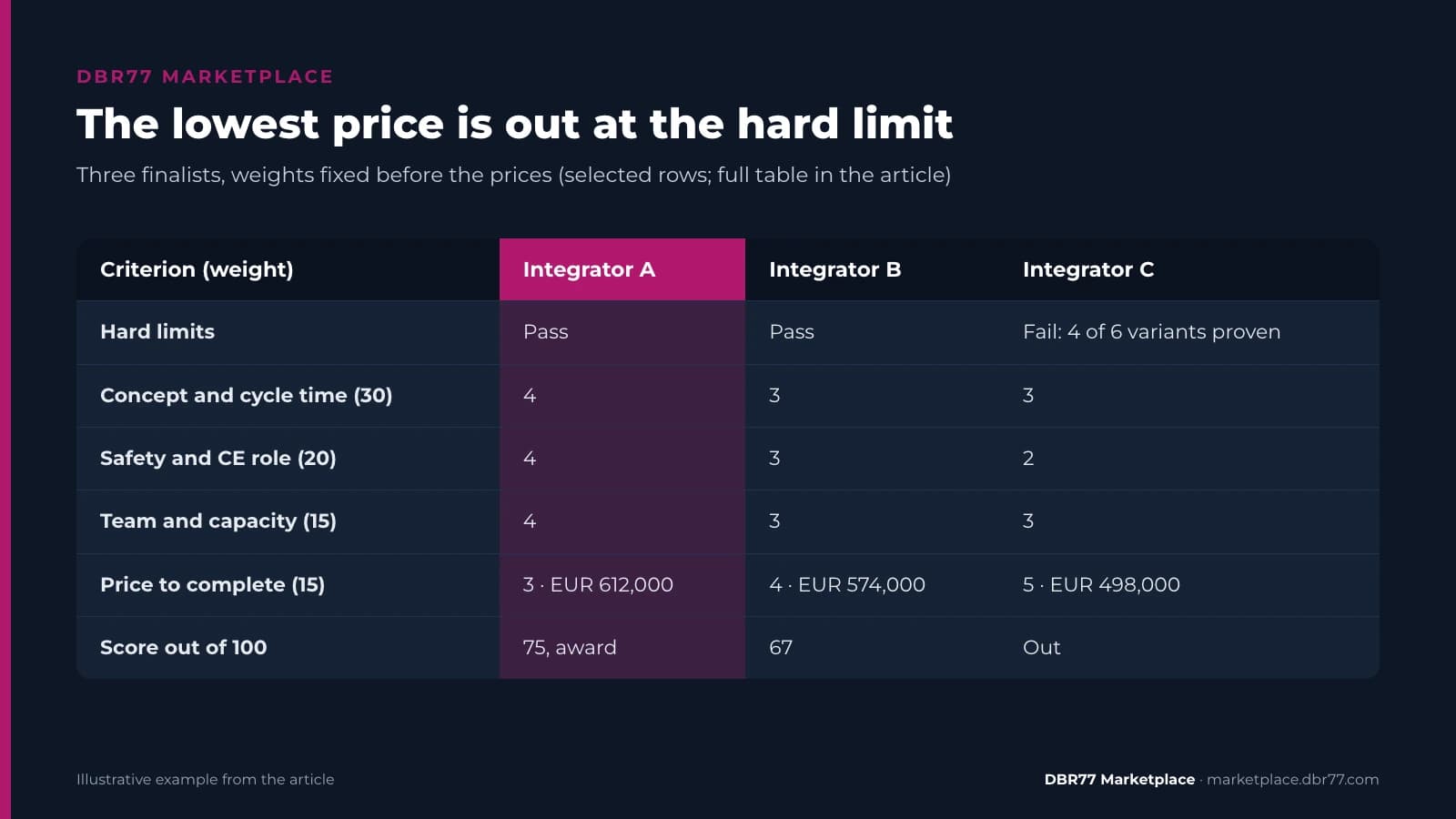
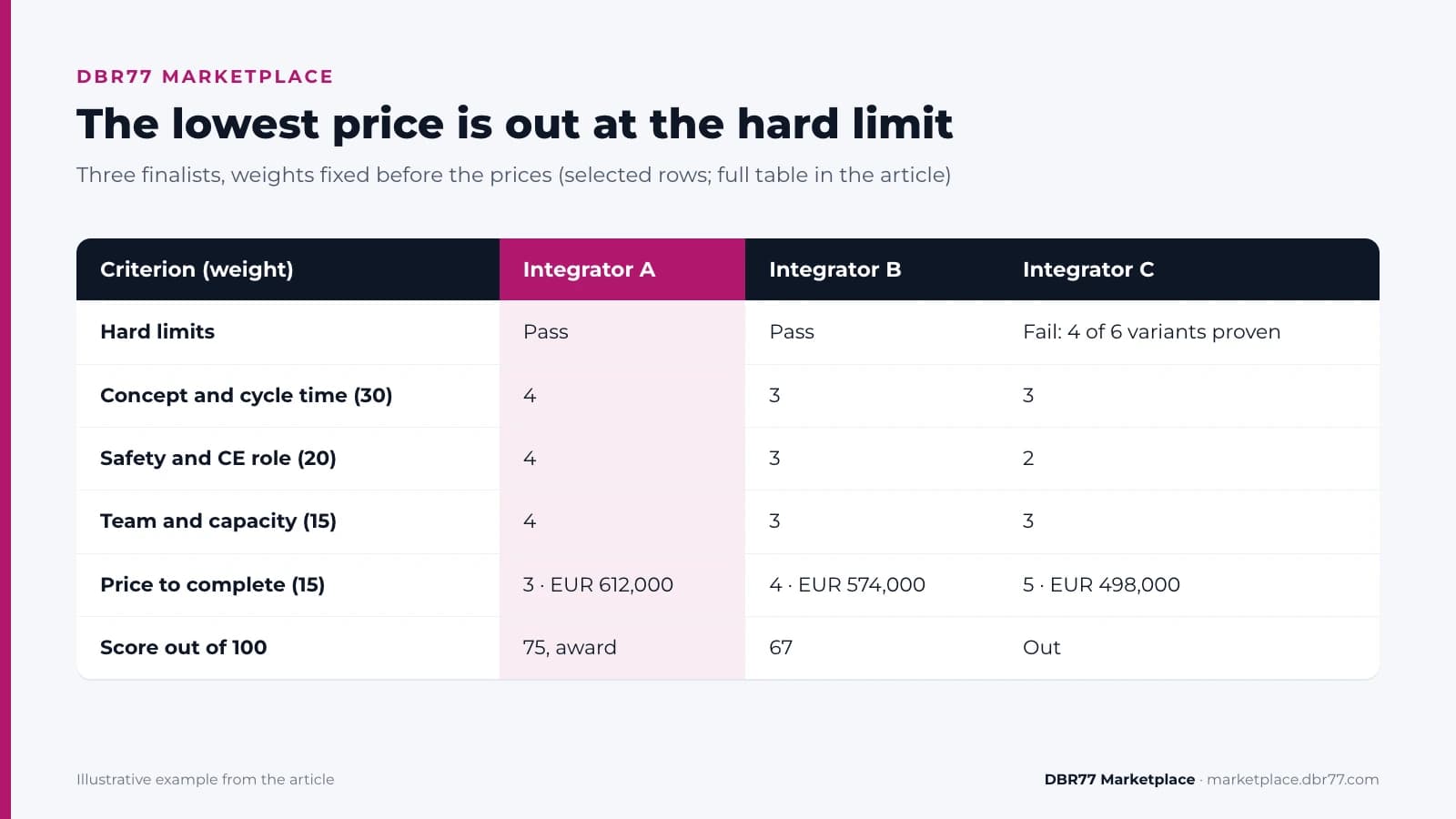
Illustrative example: three finalists for an end-of-line palletizing cell.
| Criterion (weight) | Integrator A | Integrator B | Integrator C |
|---|---|---|---|
| Hard limits: cycle time proven for all variants, manufacturer role accepted | Pass | Pass | Fail: cycle time proven for 4 of 6 variants |
| Concept fit and cycle time proof (30) | 4 | 3 | 3 |
| Safety concept and CE role (20) | 4 | 3 | 2 |
| Team and capacity (15) | 4 | 3 | 3 |
| Service near the plant (10) | 3 | 5 | 3 |
| Price to complete (15) | 3 (EUR 612,000) | 4 (EUR 574,000) | 5 (EUR 498,000) |
| Schedule (10) | 4 | 3 | 4 |
| Weighted score out of 100 | 75 | 67 | Out (64 if scored) |
In this example, Integrator C has the lowest price but fails a hard limit, so it is out before the scores count. Integrator A costs EUR 38,000 more than Integrator B and wins on concept, safety and team, which together outweigh B's lower price and better service. All numbers here are invented to show the method.
Write the decision on one page: the winner, the reason in two sentences, the conditions to fix before the contract (open assumptions, the FAT and SAT plan, the manufacturer split), and a short, factual debrief for the finalists who did not win. Then check the contract against What to Check Before Signing an Automation Contract.
How DBR77 Marketplace supports the comparison
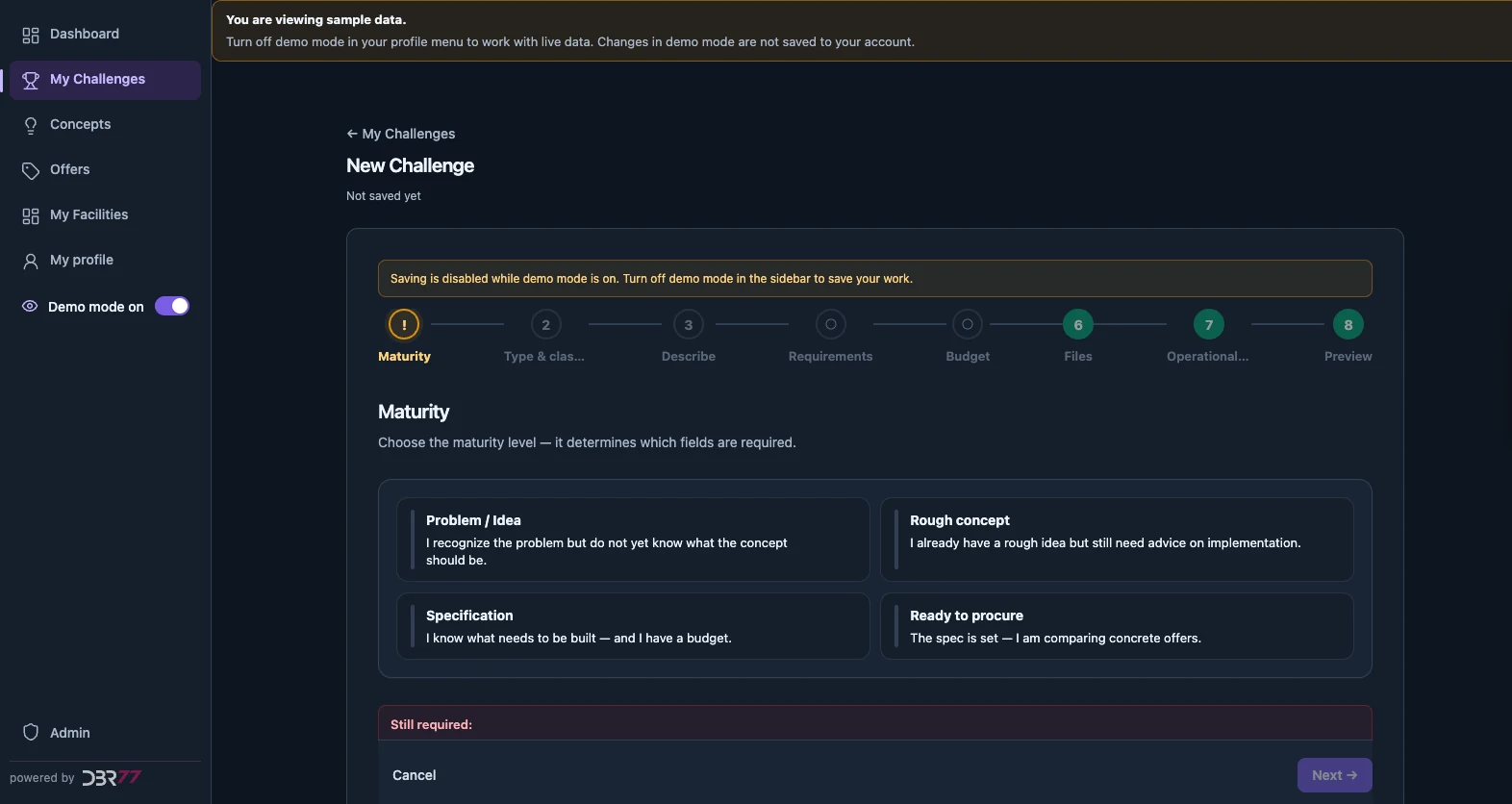
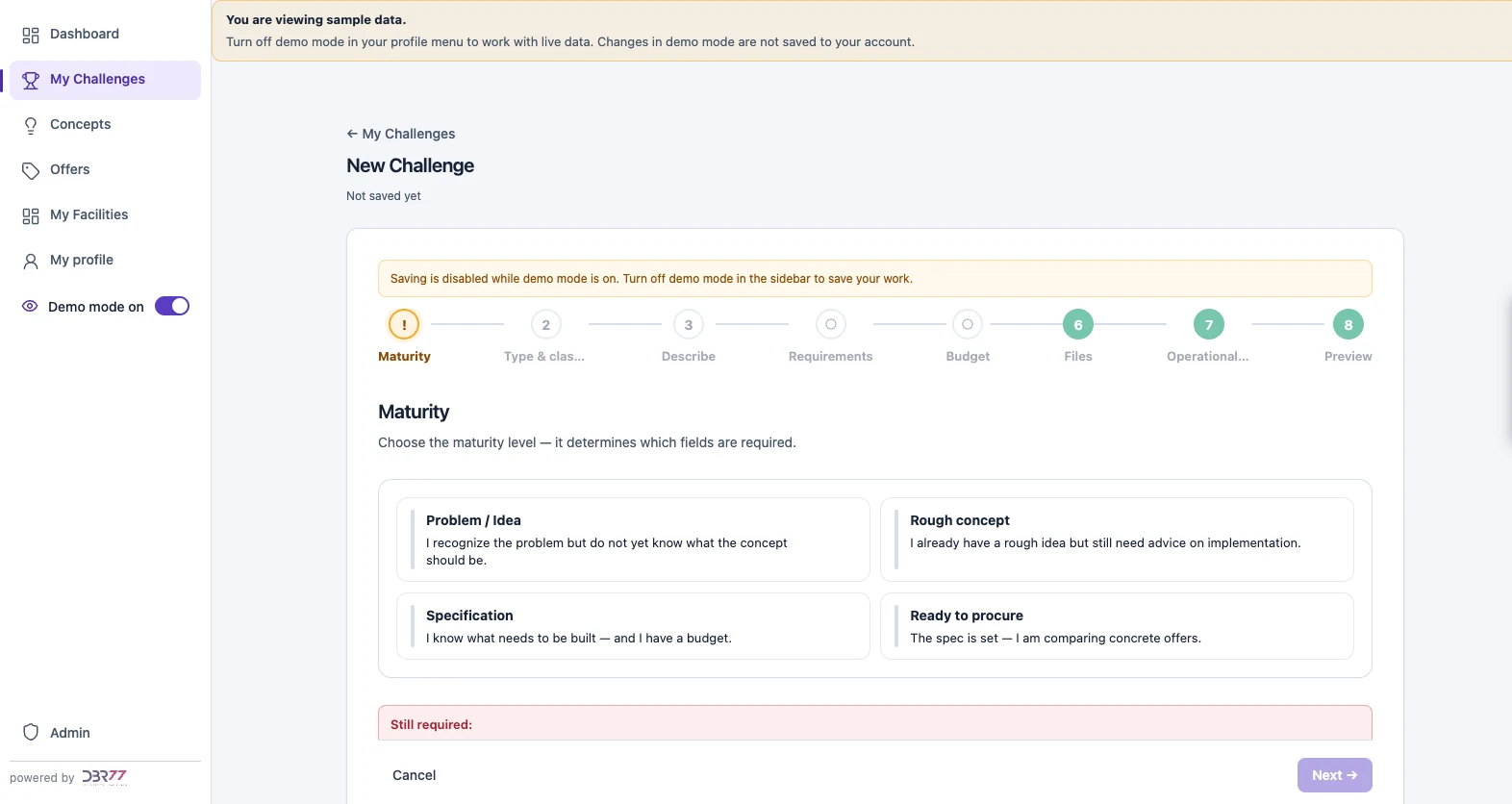
DBR77 Marketplace is where a manufacturer publishes an automation challenge, receives concepts and offers from integrators and technology suppliers, and compares them on one basis. The comparison and the award stay with you; the Marketplace keeps the material in one structure.
| Step | What you do | What DBR77 Marketplace provides |
|---|---|---|
| 1. Same basis | Write the requirements, hard limits and weights | Requirements turned into a clear format "using predefined structures and AI support"; "processes, bottlenecks, and goals are prepared so integrators understand your project faster and more precisely" (Marketplace) |
| 1. Same answers | Answer questions once, for everyone | A Q&A tab on the challenge that all integrators see |
| Finding finalists | Check proposed names against your hard filters | AI matching that proposes integrators and suppliers; an integrator view filterable by country, category and application area |
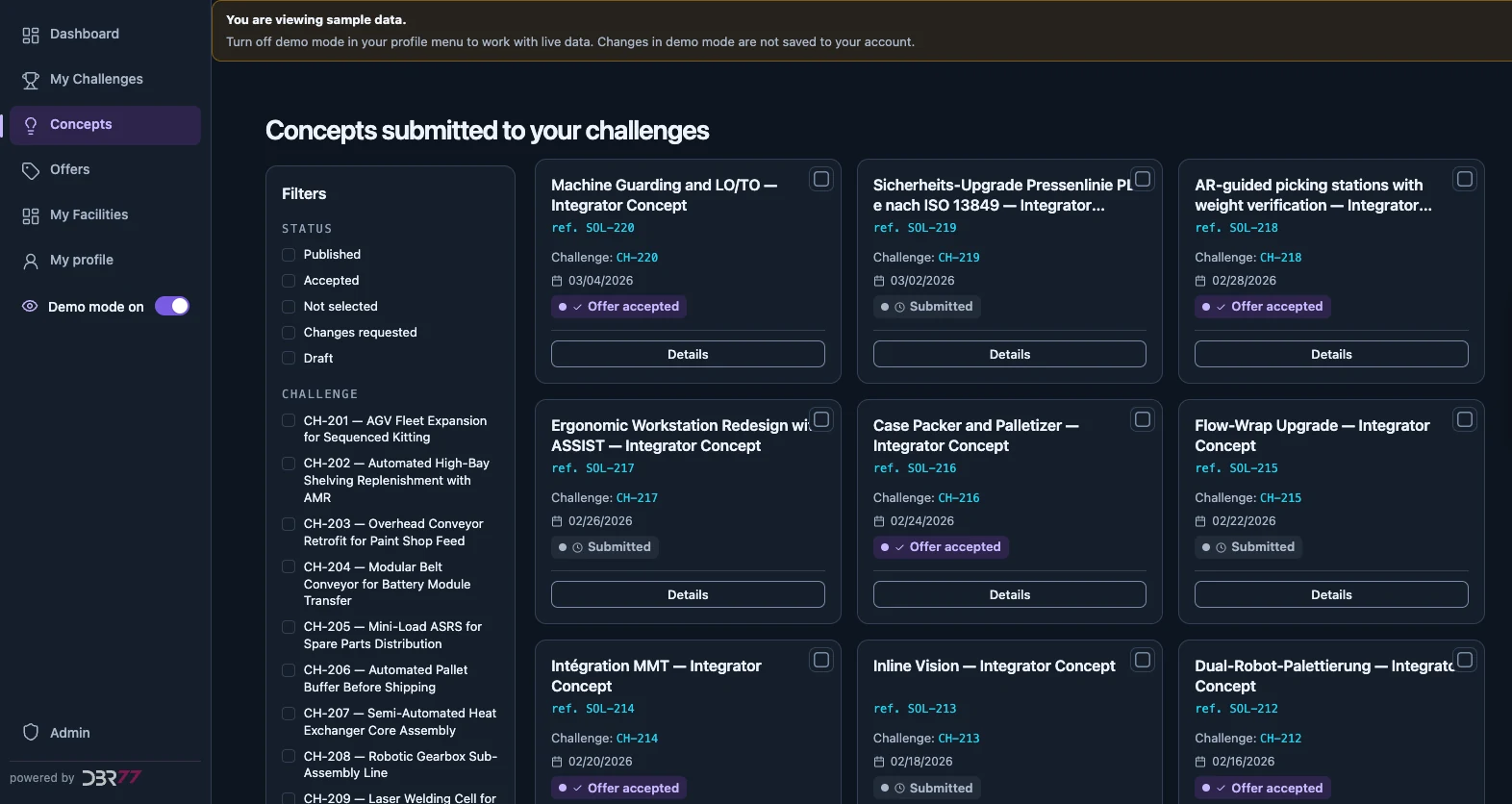
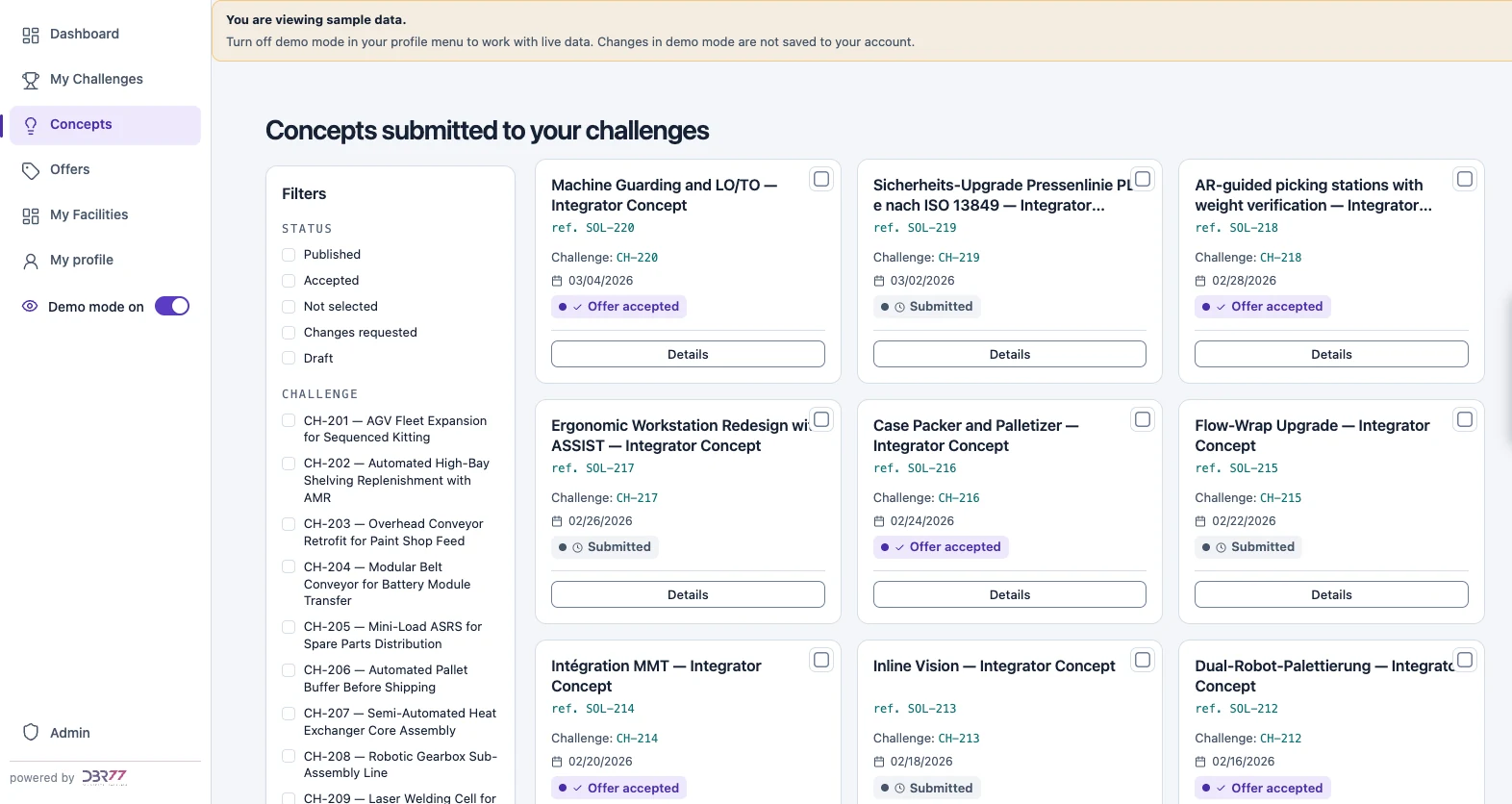
| 2 and 3. Concepts and proof | Review each concept against the same rows | Concepts submitted to your challenge, then offers, "each linked to its challenge and concept, with status, expiry date and price" (DBR77 Marketplace) |
| 6. Score and decide | Score, decide, write the award | Offers compared on the same fields: price, lead time, scope, tech stack, warranty and risk |
| Throughout | Decide what is shared | NDA-gated information, secure signing and audit trails |
A few facts set the limits of what the Marketplace does. "Verified" on DBR77 Marketplace means a person at DBR77 has checked that the company exists, is active and has experience delivering automation projects; it is not a quality guarantee for your project, so Steps 2 to 5 still apply. AI matching outputs "are probabilistic" and "should not be treated as the sole basis for supplier selection" (Product terms). DBR77 "acts as a platform facilitator and is not a direct party to transactions unless explicitly stated", and project contracts are signed directly between you and the integrator (Marketplace terms). Manufacturers use the standard marketplace for free; integrators and technology suppliers pay a commission on successful deals.
Fits when: you plan a new robot cell, end-of-line or intralogistics project, more than one integrator could build it, and you want their concepts and offers on one comparable basis with a record of what was asked and answered. Does not fit when: you are buying a like-for-like replacement machine from one OEM, or you already have a framework contract with an integrator for this type of work.
FAQ
What does a robotics system integrator do?
A robotics system integrator turns a robot into a working cell: gripper, guarding and safety functions, controls, interfaces to your machines and IT, programming, commissioning and training. ISO 10218-2 sets the safety requirements for that integration. The integrator may also take the manufacturer role for the finished cell; agree that in writing.
How many integrators should I compare?
Two to four finalists after the first concepts is a workable number. With fewer you have little to compare; with more, each concept gets less review time. Narrow a longer list with hard filters first.
Who is responsible for CE marking of a robot cell?
The manufacturer of the cell, which for an assembly of machines can be the integrator, the plant or another supplier. Agree it in writing before the award. From 20 January 2027 the EU Machinery Regulation 2023/1230 replaces the Machinery Directive, so check which rules the documents will follow.
Is a certified integrator always the safer choice?
A certification such as CSIA's shows how the company runs its business, and CSIA itself says you still need to check the technical capabilities. Use it as one input in Step 5. The concept review, the proof of performance and the manufacturer question decide.
What does "verified" mean on DBR77 Marketplace?
A person at DBR77 has checked that the company exists, is active and has experience delivering automation projects. It is not a quality guarantee for a specific project. You still compare concepts, proof and teams as described above.
Does it cost a manufacturer anything to compare integrators on DBR77 Marketplace?
No. Manufacturers use the standard marketplace for free. Integrators and technology suppliers pay a commission on successful deals.
Conclusion
Comparing robotics system integrators works when every finalist answers the same question and you decide on criteria fixed before the prices. Before the next concept arrives, write your hard limits and weights on one page and agree them with engineering, operations and procurement. Then send every finalist the same two requests: cycle time proof for every product variant, and a written answer to who will be the manufacturer of the finished cell.
Compare integrators on one basis, then award
Publish your challenge, receive concepts, then offers in the same fields and keep every answer on record. Free for manufacturers.
Sources
- European Union, Regulation (EU) 2023/1230 on machinery, 2023
- EU-OSHA, Regulation (EU) 2023/1230 on machinery, accessed 2026
- ISO, ISO 10218-2:2025 Robotics: Safety requirements, Part 2: Industrial robot applications and robot cells, 2025
- IEC, IEC 62381:2024 Automation systems in the process industry: FAT, FIT, SAT and SIT, 2024
- VDI, VDI 2519 Part 1: Procedures for the compilation of tender and performance specifications, 2001
- Control System Integrators Association, Find an Integrator and Certification FAQ, accessed 2026
- International Federation of Robotics, Global Robot Demand in Factories Doubles Over 10 Years, 2025
- DBR77, case studies: HSV (2023), automation concept (2024), Ficomirrors (2026)
- DBR77 Marketplace, home page, Marketplace, Marketplace terms and Product terms, 2026