How to Plan CNC Machine Tending Automation Before You Ask Integrators for Quotes
By DBR77 Team · Published
Before you ask for quotes on CNC machine tending automation, define the part family the cell must run, measure how long the spindle waits for the operator, and decide how many hours the cell must run without a person. Then describe how parts arrive and leave, how they are gripped and changed over, what the machine offers (automatic door, powered clamping, a robot interface) and who owns the safety of machine plus robot. Put it in one package with acceptance criteria, so every integrator quotes the same cell.
In machine tending, a robot or cobot takes a raw part, loads the lathe or machining center, waits for the cycle, unloads the finished part and puts it somewhere useful. It sounds simple, and that is why the requests sent to integrators are often one line long. This guide fills that line with the data a CNC cell needs. For the general structure of a brief, see How to Write an Automation Brief Integrators Can Quote.
Why CNC machine tending quotes come back impossible to compare
Machine tending quotes differ because each integrator fills the gaps in a vague request with its own assumptions. Send "automate loading of our CNC lathe" to three integrators and you may get a cobot on a mobile table for one part number, an industrial robot with a drawer system for ten parts and three hours of autonomy, and a pallet system for a whole family. Each offer can be right for its own assumptions, and none of them tells you what your project costs.
Robot installations keep growing. The International Federation of Robotics reports a record 5 million industrial robots in operation in 2025, and US installations grew 12% to almost 38,500 units (IFR World Robotics 2026). Germany installed fewer robots than the year before but still took 41% of all installations in the EU. Staffing adds to the case. The US Bureau of Labor Statistics projects about 30,400 openings a year for machinists and tool and die makers, an occupation that needs long-term on-the-job training (BLS). A trained machinist is worth more setting up, programming and checking parts than opening a door every six minutes.
The six steps below build one data package that every bidder quotes against.
Step 1: Define the part family the cell must run
The part family decides the gripper, the part presentation and often the robot size, so it comes first. List every part number the cell must run in its first year, including parts beyond the one that started the idea. Is this machine the right place to start at all? How to Choose the First Process to Automate helps with that question.
| Data | What to give | Why integrators need it |
|---|---|---|
| Part numbers | Count, and share of yearly volume per part | Shows whether one setup covers most of the work |
| Size range | Smallest and largest part, with drawings | Decides gripper stroke, drawer or pallet pitch |
| Weight range | Raw and finished weight in lb (kg) | Decides robot payload, including the gripper |
| Raw part form | Bar, saw-cut blank, casting, forging | Changes how parts can be stacked and picked |
| Batch size | Parts per batch and changeovers per week | Decides how much changeover time the cell can afford |
| Out of scope | Parts that stay manual | Stops integrators sizing the cell for an exception |
Example (illustrative): a lathe runs 14 part numbers. Six of them make up 80% of the volume, all saw-cut steel blanks from 1.5 to 3 in (38 to 76 mm) in diameter and under 4 lb (1.8 kg). The request names those six as the cell's scope and the other eight as manual, so every integrator designs for the same work.
Step 2: Measure spindle time, load time and operator waiting
Measure where one shift goes before anyone talks about robots. For each part, record the machining cycle, the door-to-door time to unload, load and restart, and how long the machine stands with the door open or the cycle finished while the operator is somewhere else.
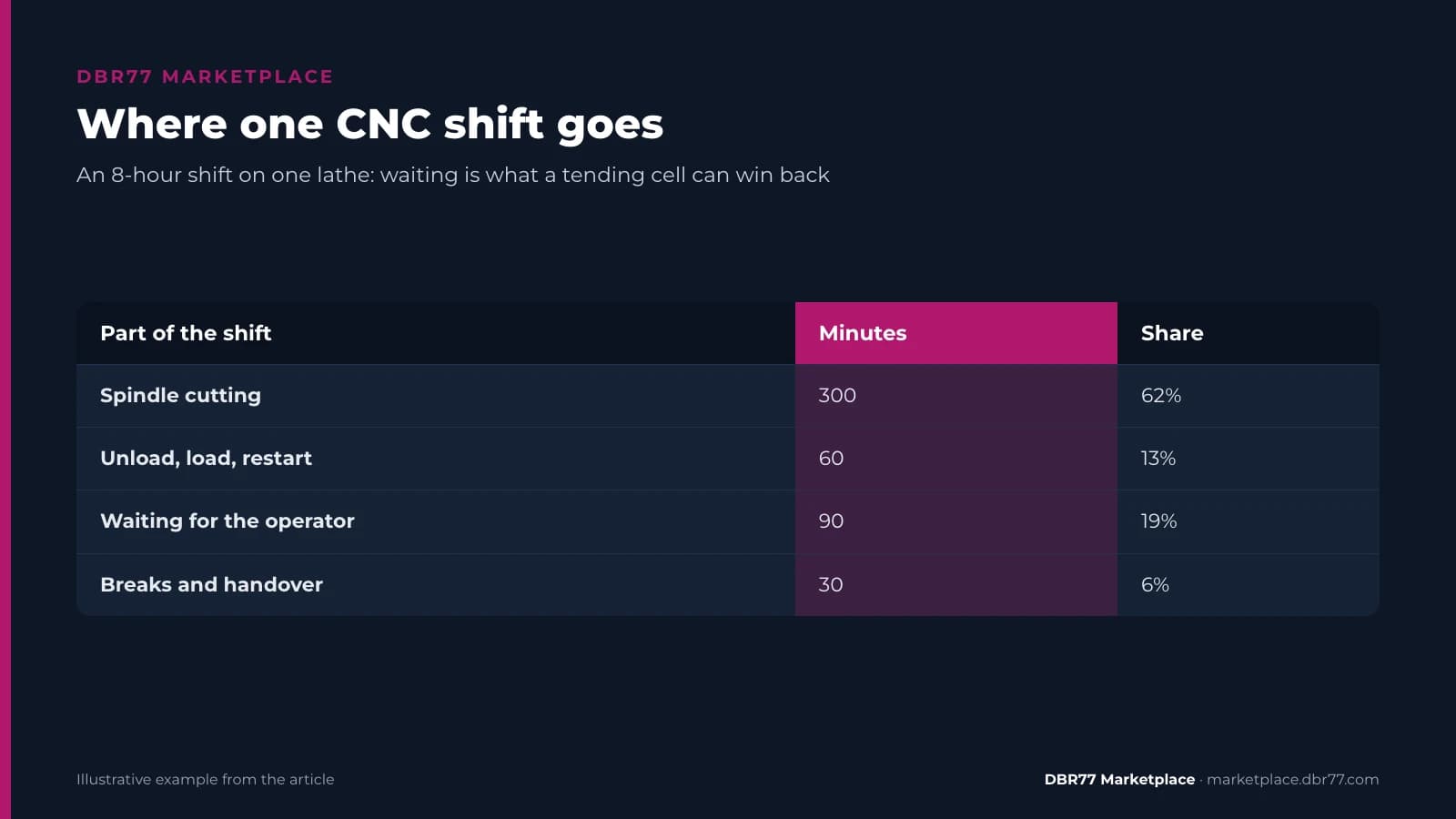
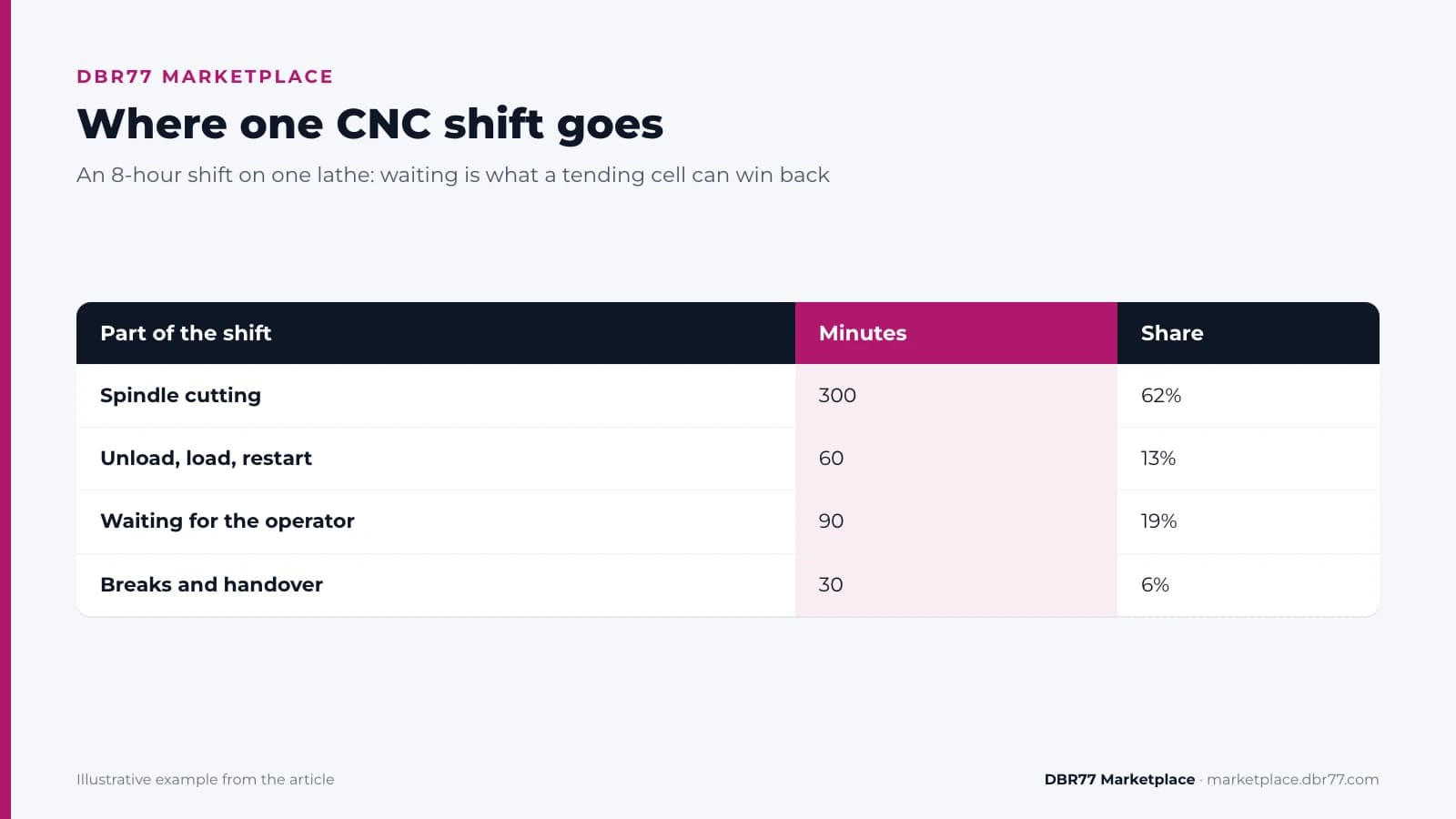
Example (illustrative): on one CNC lathe, an 8-hour shift (480 minutes) splits like this. The spindle cuts for 300 minutes. Unloading, loading, blowing off chips and restarting take 60 minutes. The finished machine waits 90 minutes for an operator who is busy at the second lathe or fetching material. Breaks and shift handover stop it for another 30 minutes. The spindle runs 62% of the shift, and 120 minutes of waiting and stops are what a tending cell can win back. If the waiting is near zero because an operator stands at the machine all the time, the case rests on freeing that person for other work.
A DBR77 concept case started from the same split. At a plastics plant with over 200 people on three shifts, the analysis put one operator's manual process at 90 seconds of activity and 98 seconds of waiting. Automation variants were then tested in a digital twin, and the technology provider was selected on the marketplace (DBR77 case study). That process was internal transport, not CNC tending, but the first question was the same: how much of the operator's time is work, and how much is waiting?
Machine data gives better numbers than a stopwatch. Our IIoT article on what data to collect from machines explains which signals show real cycle and idle time.
Then set the autonomy target: how many hours the cell must run with nobody there (breaks, the last hour of a shift, a night shift). That one number drives raw part capacity, tool life, chip handling and in-process measurement. A cell that must run for 30 minutes is a different project from one that must run for 8 hours.
Publish your machine tending project as a Technology Challenge
Bring your part list, cycle data and photos of the machine. Integrators answer with concepts and offers in one standard format, and manufacturers use the marketplace for free.
Step 3: Decide how parts arrive and leave the cell
Part presentation is the decision that sets the cell's autonomy and footprint. Integrators can offer several ways to bring raw parts to the robot and take finished parts away. State what your parts and your autonomy target need, and ask each integrator to say which option it quotes and why.
| Option | Fits when | Watch for |
|---|---|---|
| Fixed table or tray loaded by hand | Short runs, few parts per batch, short autonomy | An operator refills it often |
| Drawers or stacked trays | Medium runs, parts that sit in a grid or a nest | Nests per part number add changeover work |
| Pallet or grid system with positioning | Longer runs, many parts, longer unattended time | Floor space and loading access |
| Conveyor in and out | Steady flow from or to another process | Part orientation at the pick point |
| Bin picking with vision | Parts that arrive loose | Part shape, reflections and cycle time |
Write down what happens to finished parts too: orientation, separation so faces do not touch, washing or blowing off, deburring, marking, and how parts for inspection are set aside. These small tasks often end up in the robot cycle, and an integrator who does not know about them cannot quote them.
Step 4: Plan gripping, part flip and changeover
Gripping and changeover decide whether the cell still runs after the first new part number. Answer these questions in the package:
- Raw and finished part. Does the raw part grip the same way as the finished one? A double gripper lets the robot unload and load in one visit; ask whether your parts need one.
- Second operation. Must the part be flipped for a second clamping, on the same machine or a second one?
- Jaws and fixtures. Are the chuck jaws or vise jaws changed per part number? Soft jaws are often machined per part, and someone has to change them.
- Gripper fingers. Who changes them, how long may it take, and is a tool changer worth it for your part count?
- Changeover time. State it as a requirement, for example "a trained operator changes the cell from one part number to another in under 15 minutes" (illustrative value).
Check the whole part family, not one sample. In an earlier project on DBR77's Robot Platform, HSV Polska's first inquiry held all the technical requirements, and a 3D simulation on the platform confirmed a line cycle time below 120 seconds for all product codes in the project (HSV case study). That line did quality control and packing, not CNC tending. Reach, layout and cycle can also be tested in a simulation first; see Before You Buy a Robot, Simulate It First.
Step 5: Describe the machine interface and the safety owner
The CNC machine has to cooperate with the robot, and that is where many tending projects grow. Give integrators the facts about each machine:
- Control make, model and age, and the machine builder's contact.
- Automatic door: present, retrofit possible, or not available.
- Powered clamping (pneumatic or hydraulic chuck or vise): present or needed.
- Free inputs and outputs, or a robot interface option offered by the machine builder.
- Chips and coolant: chip type, how chips are cleared today, coolant on parts and fixtures.
- In-process gauging, tool breakage detection and tool life monitoring, if the machine has them.
The robot and the machine also need an agreed exchange of signals: machine ready, door open and closed, part clamped and unclamped, cycle start, cycle end and alarms. Do not invent signal names in the RFQ. Ask the machine builder what the control offers and let the integrator confirm it. For monitoring and job data (not for the safety signals), ask whether the machine offers OPC UA for Machine Tools, which describes a common interface "among machine tools of different technologies, manufacturers and model series".
Safety needs one owner. Machining centers have their own safety standard, ISO 16090-1:2022, which also covers workpiece loading devices when they are an integral part of the machine (turning machines have ISO 23125). A robot cell around the machine is a robot application under ISO 10218-2:2025, which covers the integration of machines and components and complements ISO/TS 15066 for collaborative applications. The RFQ should say who takes responsibility for the combined cell: door interlocks, clamping, guarding and the risk assessment.
Plan for the moments when people enter the cell. OSHA notes that many robot accidents occur during non-routine conditions "such as programming, maintenance, testing, setup, or adjustment" (OSHA Robotics). In a tending cell that means refilling parts, changing jaws and grippers, clearing chips and fixing jams. The risk assessment for that application decides whether the cell runs collaborative or behind guarding.
In the EU, the Machinery Regulation (EU) 2023/1230 applies from 20 January 2027; machinery placed on the market before that date must comply with the Machinery Directive 2006/42/EC (European Commission). For a robot added to an existing CNC machine, ask who issues the declaration of conformity for the combined cell.
Step 6: Set acceptance criteria and publish the package as one challenge
Write down what the cell must prove before you ask for quotes, so every integrator prices the same tests. For a tending cell, that usually means:
- A run with every part number in scope at the agreed cycle time.
- An unattended run for the target number of hours, with no operator touch.
- A timed changeover between two part numbers.
- Part quality: first-part approval and the in-process checks the cell must keep.
- Safety validation of the combined cell before production.
How to Set Acceptance Criteria, FAT and SAT turns this list into a test protocol, and What to Include in an Automation RFQ or RFP covers the commercial part.
Publish the package as a Technology Challenge on DBR77 Marketplace, the brief a plant publishes to ask integrators for solutions. Machine tending is among the production automation applications listed on the marketplace homepage:
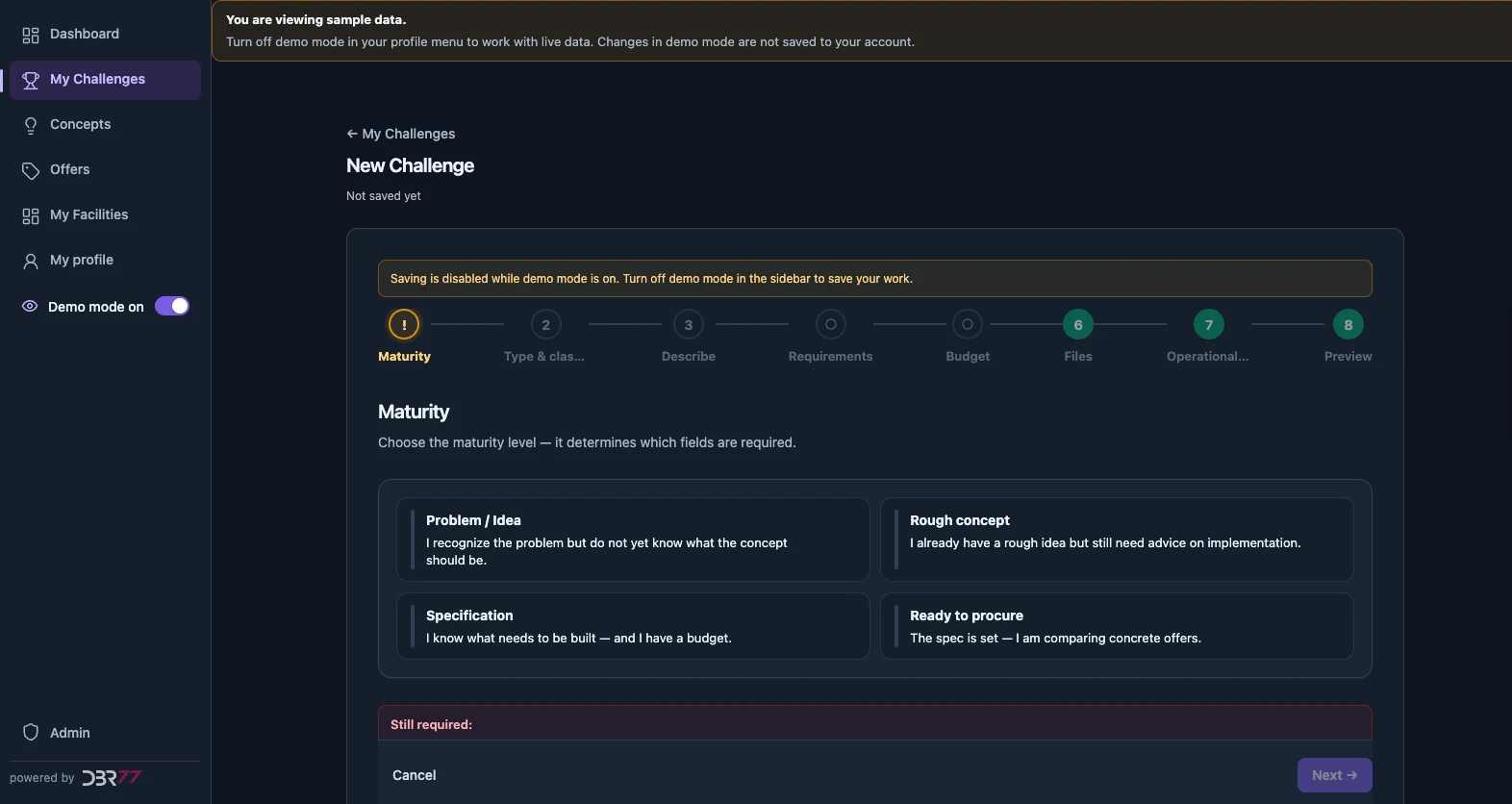
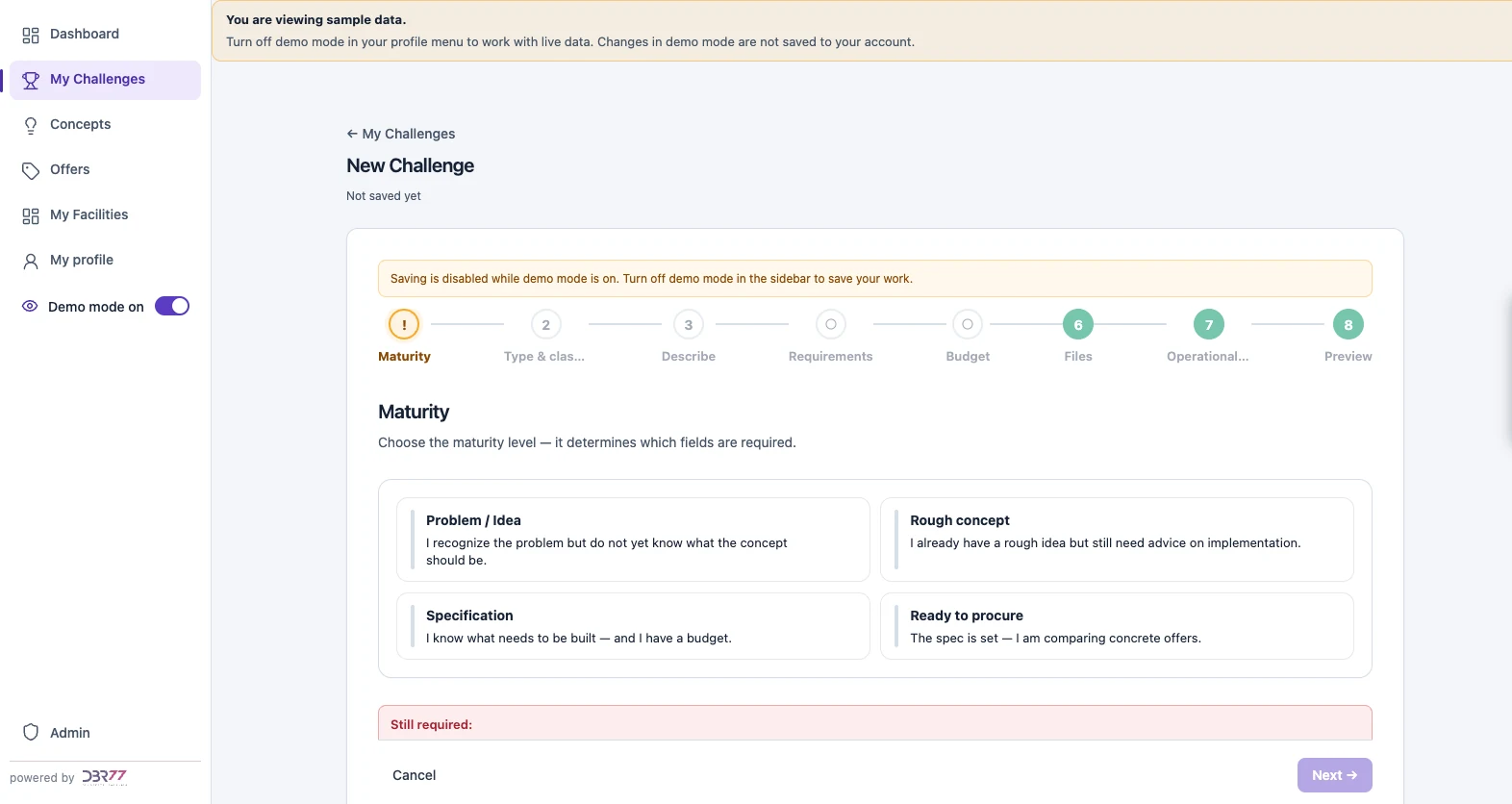
- The wizard. It has eight steps. The first sets the project's maturity, which decides the required fields; then come the description, requirements, budget, files and operational assumptions, and a preview before publication. DBR77 experts review the challenge before it goes live.
- Drawings behind the NDA. A published challenge first shows an executive summary, the budget range and the deadlines. Details open in a separate view once the standard mutual NDA is signed with DocuSign, so part drawings and cycle data can sit there.
- Questions. A Q&A tab collects integrators' follow-up questions, so every bidder sees the same answers.
- Concepts and offers in one format. Delivery time, warranty, payment terms, installation, training and support are listed per offer, so scope, price and terms sit side by side. How to Compare Automation Offers Side by Side shows how to read them. From an accepted offer you can generate a contract and send it for signing.
- Verified companies. "Verified" means a person at DBR77 has checked that the company exists, is active and has experience delivering automation projects. It is not a quality guarantee for a specific project.
- Cost. Manufacturers use the standard marketplace for free; integrators and technology suppliers pay a commission on successful deals.
Ficomirrors Polska, a Tier-1 automotive supplier, stated requirements such as integration with its existing IT infrastructure and pallets weighing up to about 550 lb (250 kg), and received proposals from several integrators in one standardized format (Ficomirrors case study). That project was AGV transport, not machine tending, but a CNC challenge with part weights, cycle data and an autonomy target works the same way.
FAQ
Cobot or industrial robot for CNC machine tending?
It depends on part weight with the gripper, cycle time, autonomy target, floor space and the risk assessment. In OSHA's words, collaborative applications are designed for direct interaction with workers, while other robot applications are typically separated from workers by machine safeguarding (OSHA Technical Manual). Describe your needs and let integrators propose; then compare their assumptions.
What spindle utilization makes machine tending worth it?
There is no universal threshold. Compare the hours you can win back (operator waiting, breaks, unattended time) and the operator time you free with the cost of the cell. Measure first, so the comparison rests on your own numbers.
Can one robot tend two CNC machines?
Sometimes, if both cycles leave the robot enough time and the layout lets it reach both doors. Measure both cycles, include changeovers, and check the layout and cycle in a simulation before you ask for quotes.
Do I need an automatic door and powered clamping on my CNC machine?
Usually, yes. The robot needs a door and a clamp it can open and close on a signal, which a manual door or a hand-tightened vise does not offer. Ask your machine builder whether a retrofit is available before the RFQ, and put the answer in the package.
How many hours can a machine tending cell run unattended?
As many as raw part capacity, tool life, chip handling, measurement and alarm handling allow. Set the target first; it decides much of the cell's design and price.
What does an integrator need from me to quote machine tending?
The part family with drawings, cycle and waiting times, the autonomy target, how parts arrive and leave, gripping and changeover needs, the machine facts and safety owner, and acceptance criteria. Add photos and a short video of the machine and the area around it.
Conclusion
This week, pick the machine you want to automate and measure one full shift: spindle time, load time and waiting. Then list the part numbers it runs, mark the ones in scope and ask the machine builder about the door, clamping and robot interface. With those three pieces of data in hand, you can fill in the rest of the package, and the quotes you get back will describe the same cell.
Get comparable machine tending offers
Post your CNC machine tending package as a Technology Challenge on DBR77 Marketplace, or ask our team to look at it before you publish.
Sources
- International Federation of Robotics, Five Million Robots Now Operate in Factories Globally (World Robotics 2026), 2026
- U.S. Bureau of Labor Statistics, Machinists and Tool and Die Makers, Occupational Outlook Handbook, 2026
- ISO, ISO 10218-2:2025 Robotics: Safety requirements, Part 2: Industrial robot applications and robot cells, 2025
- ISO, ISO 16090-1:2022 Machine tools safety: Machining centres, milling machines, transfer machines, Part 1, 2022
- OPC Foundation, OPC 40501-1 OPC UA for Machine Tools, Part 1: Machine Monitoring and Job Management
- OSHA, Robotics and OSHA Technical Manual, Section IV, Chapter 4: Industrial Robot Systems
- European Commission, Machinery: Regulation (EU) 2023/1230
- DBR77, Case study: Development of an automation concept, 2024
- DBR77, HSV case study: A success story on the Robot Platform, 2023
- DBR77, How DBR77 Marketplace stabilized logistics for a Tier-1 automotive supplier (Ficomirrors), 2026